

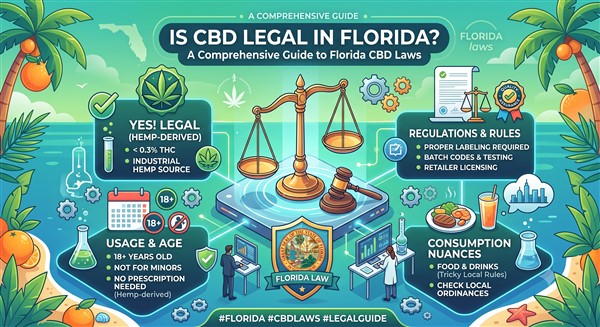
If you live in Florida or are planning to visit the Sunshine State, you might be wondering: is CBD legal in Florida? The answer is yes, but the legal landscape is more nuanced than a simple yes or no. While hemp-derived CBD products are legal under both federal and Florida law, the state has established a regulatory framework that continues to evolve. Recent legislative developments, enforcement trends, and upcoming federal changes have created a complex environment that can confuse consumers and business owners alike. This guide provides a clear, factual overview of CBD legality in Florida. It covers the current legal status of CBD oil in Florida, explains recent regulatory developments, and highlights what consumers need to know about purchasing and using CBD products in the state.
The Short Answer: Is CBD Oil Legal in Florida?
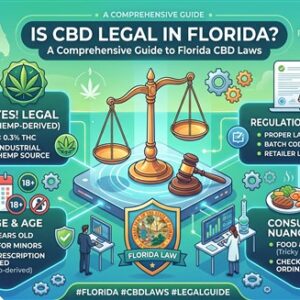
Yes, CBD oil is legal in Florida, but with important conditions. Under Florida law, hemp-derived CBD products with less than 0.3 percent delta-9 THC are legal. This aligns with the federal definition of hemp established by the 2018 Farm Bill. Florida classifies itself as a state with conditional CBD legality, meaning access is primarily through the medical marijuana program. Hemp-derived CBD products remain available without a prescription, but broader cannabis access is restricted to qualified medical patients.
The Current Legal Framework for CBD in Florida
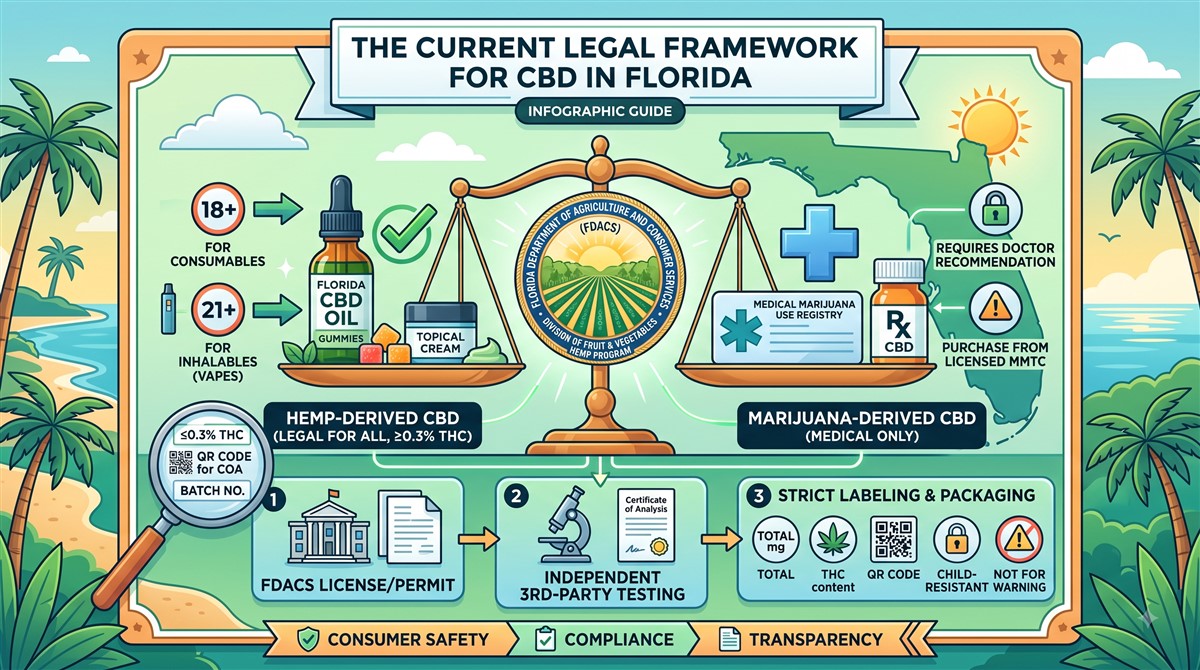
Understanding whether CBD is legal in Florida requires familiarity with both state and federal laws. Two primary sources of law govern this space: the 2018 Farm Bill at the federal level and Senate Bill 1020, which Florida enacted in 2019.
Federal Law and the 2018 Farm Bill
The 2018 Farm Bill legalized hemp and hemp-derived products at the federal level, provided they contain no more than 0.3 percent delta-9 THC on a dry weight basis. This legislation removed hemp from the Controlled Substances Act and opened the door for the CBD industry to grow nationwide. However, the federal landscape is not static. A new federal law takes effect on November 12, 2026, and this law will redefine hemp and impose stricter THC limits. This change could affect the legality of many hemp-derived products currently available in Florida and across the United States. For more information on federal regulations, you can visit the FDA’s Cannabis Products page.
Florida Senate Bill 1020
In 2019, the Florida Legislature passed Senate Bill 1020. This bill created a state hemp program within the Department of Agriculture and Consumer Services to regulate the cultivation of hemp in the state. The bill clarified that “hemp-derived cannabinoids, including, but not limited to, cannabidiol, are not controlled substances or adulterants”. This legislation aligned Florida with the federal definition of hemp and created a legal pathway for CBD products in the state.
The Florida Medical Marijuana Program
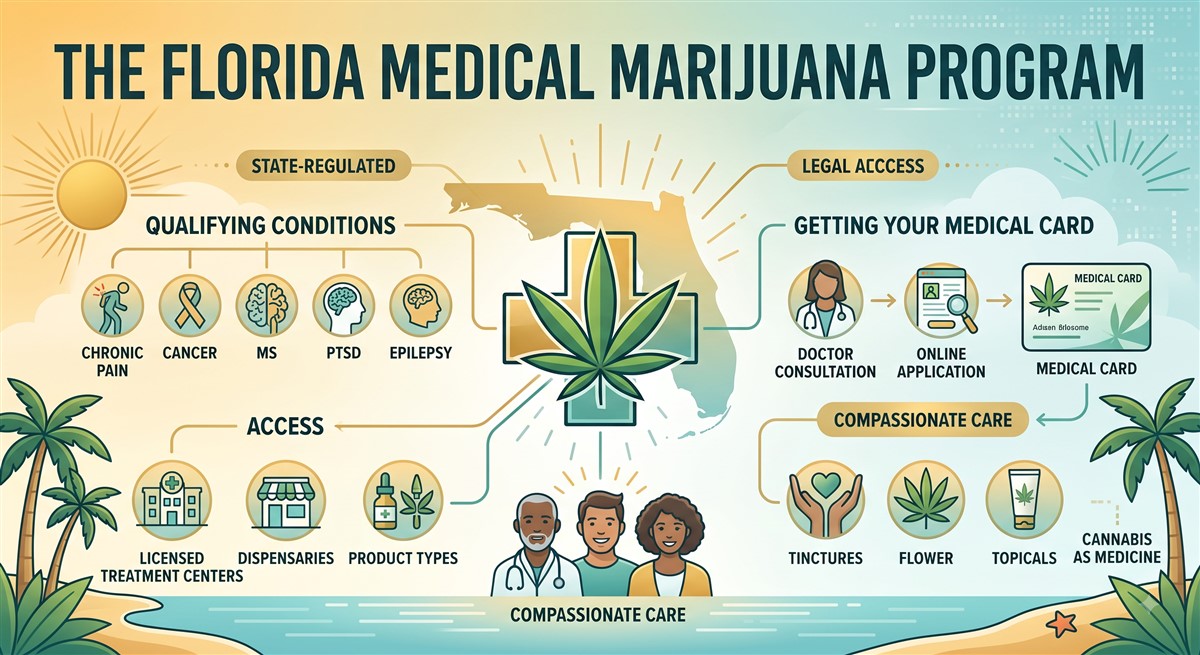
Florida has a well-established medical marijuana program that provides access to cannabis-derived products for qualified patients. Following the approval of Amendment 2 in 2016, Florida expanded its medical marijuana program. This expansion allowed CBD products with high levels of both CBD and THC for residents over 21 with qualifying medical conditions.
How the Program Works
Under Florida Statute 381.986, residents must have a medical marijuana card issued by the state. They must first receive a recommendation from a certified physician. Licensed Medical Marijuana Treatment Centers are the only entities legally allowed to grow, process, and sell medical marijuana in Florida. A doctor cannot prescribe hemp-derived CBD, but they can recommend cannabis-derived CBD as part of a patient’s medical marijuana treatment plan if the patient qualifies.
Program Limitations
The medical marijuana program is limited in scope. It serves patients with specific qualifying conditions. Access requires a physician’s recommendation and state registration. For most Floridians, hemp-derived CBD products remain the most accessible option. These products do not require a medical recommendation and are available at retail stores across the state, provided they comply with the 0.3 percent THC limit.
Recent Legislative Developments in Florida
The Florida Legislature has been active on hemp and CBD issues, though not all proposed bills have become law.
Senate Bill 1270 (2026)
Senate Bill 1270, filed in the 2026 legislative session, would have provided conditions for the manufacture, delivery, offer for sale, distribution, or sale of hemp extract. The bill would have required the Department of Agriculture and Consumer Services to preapprove advertisements and required businesses to keep records pertaining to lab results of hemp extract products. However, the bill died in the Senate Agriculture Committee on March 13, 2026. Consequently, Florida’s 2026 legislative session concluded without aligning state law with the new federal standards that take effect later this year.
House Bill 1409 (2026)
House Bill 1409, which would have provided that marijuana testing laboratories may acquire hemp and hemp extract only from certain businesses, also died in committee.
Taxation of Hemp Consumable THC Products
House Bill 7029, which would have provided excise taxes for hemp consumable THC products, died on the Second Reading Calendar. Similarly, House Bill 7027, which would have revised requirements relating to hemp consumable THC products, also died.
What Changed in Florida’s Controlled Substance Schedules?
In August 2025, Florida updated its controlled substance schedules to address a growing issue: altered or synthetic compounds being added to CBD products. One key change involves 7-hydroxymitragynine, often called “7-hydroxy” or “70.” This substance is now illegal to include in CBD products in Florida.
Enforcement Trends
Florida and the federal government are increasing enforcement in the cannabis and CBD space. This trend has become particularly noticeable after 2025 updates to controlled substance schedules. Recent enforcement trends focus on several areas:
-
Product composition: Adding prohibited compounds like 7-hydroxy
-
Labeling and marketing: Claims that suggest psychoactive or medical effects without approval
-
Distribution practices: Selling across state lines or through unregulated channels
-
Retail sales: Products that resemble controlled substances or exceed THC limits
These cases do not always start as criminal investigations. Many begin with inspections, complaints, or administrative reviews. However, these cases can escalate quickly.
The Federal Outlook: November 2026 and Beyond
The future of CBD legality in Florida is also tied to federal developments. Section 781 of Public Law 119-37 takes effect on November 12, 2026.
What Changes Federally
The new federal law narrows the definition of hemp in three important ways. First, the new federal definition uses total tetrahydrocannabinols concentration, including THCA, rather than the old delta-9-only formulation. Second, Section 781 excludes certain hemp-derived cannabinoid products if they contain cannabinoids that are not capable of being naturally produced by Cannabis sativa L., or cannabinoids that are capable of being naturally produced but were synthesized or manufactured outside the plant. Third, and most dramatically for consumers, the law removes from “hemp” any final hemp-derived cannabinoid product containing more than 0.4 milligrams combined total per retail container of total THC and other HHS-determined THC-like cannabinoids.
The Florida-Federal Mismatch
Florida law differs from the new federal standard. Florida Section 581.217 defines hemp by total delta-9-tetrahydrocannabinol concentration. Florida Rule 5K-4.034 defines that term as Δ9-THC + (0.877 × Δ9-THCA) for hemp and hemp extract intended for human consumption. Florida has not adopted Public Law 119-37’s federal 0.4 mg per-container cap or its broader framework. This mismatch matters because, after November 12, 2026, a product may fail the federal hemp definition while still requiring a separate Florida-law analysis in a Florida criminal prosecution. Because the 2026 Florida legislative session concluded without aligning state law with the new federal standards, a significant regulatory gap is likely to emerge.
What Products Are Legal in Florida?
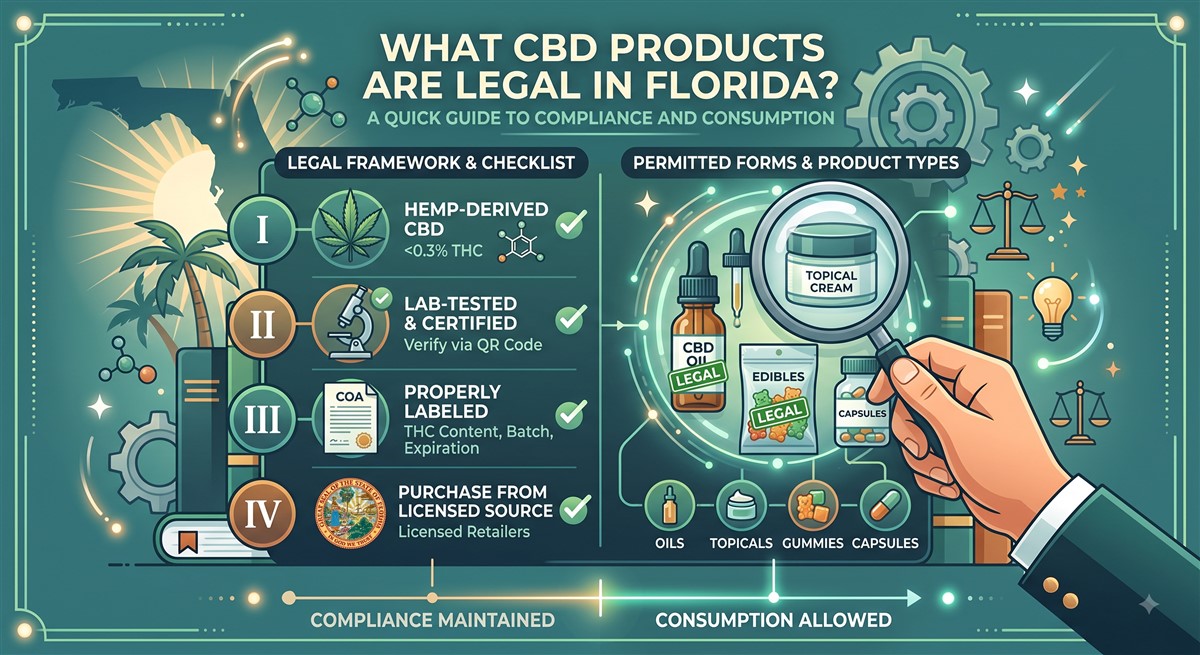
The legal status of specific CBD products in Florida depends on their cannabinoid content and form.
Currently Legal
CBD Oil and Tinctures: CBD oil with less than 0.3 percent delta-9 THC remains legal under Florida law.
CBD Edibles and Gummies: These products remain legal as long as they comply with the 0.3 percent THC limit.
CBD Topicals: Topical products like creams and lotions are generally considered cosmetics and do not require specific licensing.
Hemp Extract: Under Florida Statute 581.217, hemp extract means a substance or compound intended for ingestion containing more than trace amounts of a cannabinoid, or for inhalation, which is derived from or contains hemp and does not contain controlled substances.
Restricted or Banned
Products with Prohibited Compounds: Products containing substances like 7-hydroxy are now prohibited in Florida.
Products Exceeding THC Limits: Any CBD product with a THC concentration superior to 0.3 percent is considered a controlled substance under federal and state law.
Products with Certain Additives: Florida law prohibits products that are “attractive to children.” This means manufactured in the shape of humans, cartoons, or animals, or resembling existing candy products.
Licensing Requirements for CBD Businesses
While consumers do not need a license to buy and use CBD products, the requirements for businesses are different.
Business Licensing
It is illegal to grow hemp or manufacture, distribute, or sell hemp-based products without a proper license issued by the Department of State. A company selling hemp derivatives in an ingestible form must have adequate food licensing. Additional license requirements apply for CBD products with dairy or frozen ingredients. An exception applies to the sale of topical CBD products, which are considered cosmetics.
Hemp Food Establishments
Each establishment distributing products consisting of or containing hemp or hemp extract intended for human consumption must be permitted as a Hemp Food Establishment. Businesses must comply with all applicable rules or risk administrative enforcement, such as stop-sale orders and administrative penalties.
What Consumers Need to Know
If you are considering purchasing CBD oil in Florida, here are some practical tips:
Check the Label: Look for products that clearly state the CBD content and confirm that the THC content is below 0.3 percent.
Verify Third-Party Testing: Reputable brands provide Certificates of Analysis from independent laboratories. These documents confirm the product’s cannabinoid content and verify that it meets safety standards. For official information on Florida’s hemp program, visit the Florida Department of Agriculture and Consumer Services Hemp Program page.
Understand the Risks: The legal landscape is changing rapidly. Products that are legal today may become restricted or banned in the future, especially after the November 2026 federal changes take effect.
Buy from Reputable Sources: Brands like Hemp Therapies prioritize transparency and compliance with state regulations. Choosing a reputable brand can help ensure you are getting a product that meets legal standards.
Be Aware of Age Restrictions: You must be 21 or older to purchase many hemp products in Florida.
Frequently Asked Questions
Is CBD legal in Florida?
Yes, hemp-derived CBD products with less than 0.3 percent delta-9 THC are legal in Florida. However, the state has conditional CBD legality, with access primarily through the medical program.
Is CBD oil legal in Florida?
Yes, CBD oil is legal in Florida as long as it contains less than 0.3 percent delta-9 THC.
Is hemp legal in Florida?
Yes, hemp is legal in Florida. The state hemp program was created within the Department of Agriculture and Consumer Services to regulate the cultivation of hemp.
Do I need a prescription for CBD in Florida?
No. Hemp-derived CBD products with less than 0.3 percent THC are available over the counter without a prescription.
Can I buy CBD online in Florida?
Yes, you can purchase CBD products online and have them shipped to Florida, provided they comply with state and federal laws.
What is the age limit for buying CBD in Florida?
You must be 21 or older to purchase many hemp products in Florida.
What is changing in federal law?
A new federal law takes effect on November 12, 2026. This law will impose a strict 0.4 mg total THC cap per container, which could reclassify many hemp-derived products.
Conclusion
So, is CBD legal in Florida? The answer is yes, but with significant caveats. Hemp-derived CBD products with less than 0.3 percent delta-9 THC remain legal under both state and federal law. Florida has a well-established medical marijuana program that provides access to cannabis-derived products for qualified patients, while hemp-derived CBD products are available to consumers without a prescription. However, the regulatory environment is complex and rapidly changing. The state has updated its controlled substance schedules to prohibit certain compounds, increased enforcement in the cannabis and CBD space, and considered legislation that would have further regulated hemp products.
A federal law scheduled to take effect in November 2026 could also dramatically reshape the market. Because Florida’s legislative session concluded without aligning state law with these new federal standards, a significant regulatory gap is likely to emerge. For consumers, staying informed is essential. Understanding the current legal landscape can help you make informed decisions about purchasing and using CBD products in Florida. Reputable brands like Hemp Therapies prioritize compliance with state and federal regulations, ensuring their products meet the highest standards of quality and transparency. The future of CBD in Florida remains uncertain. What is clear, however, is that the industry will continue to evolve as lawmakers, regulators, and the courts shape the legal framework. Whether you are a consumer or a business owner, staying informed about these developments is the key to navigating the complex world of CBD legality in Florida.
Educational and Regulatory Disclaimer
This article is for educational and informational purposes only and is not medical advice. It does not recommend a dose or claim that a dietary supplement or CBD product diagnoses, treats, cures, mitigates, or prevents any disease. Dietary-supplement structure/function and general-well-being claims must be truthful, non-misleading, and substantiated; a disclaimer does not replace adequate evidence.3 Consult a qualified healthcare professional before using a dietary supplement, especially if you are pregnant or nursing, take medication, have a medical condition, or are considering a high dose.
These statements have not been evaluated by the Food and Drug Administration. This product is not intended to diagnose, treat, cure, or prevent any disease.