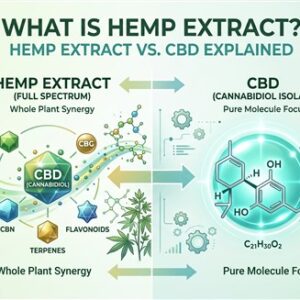


CBD and CBN sit two letters apart on a lab panel. Hemp labels often list both. What the short names hide is that the two arrive by different routes. One is a cannabinoid the plant builds on purpose. The other is mostly what happens to a plant compound over time.
That single difference runs through everything else. It shapes how each one is made, how a bottle holds up on a shelf, and what a lab panel has to report.
CBD vs CBN: The Short Answer
CBD stands for cannabidiol. CBN stands for cannabinol. Both are cannabinoids found in the cannabis plant.
The hemp plant makes CBD through its own chemistry. CBN forms when THC breaks down. Leave THC in warmth, light and air for long enough and some of it becomes CBN.
So CBD is a product of the plant. CBN is a product of time. That is the difference between CBD and CBN in one line.
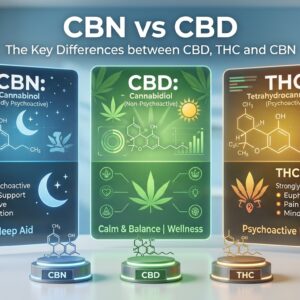
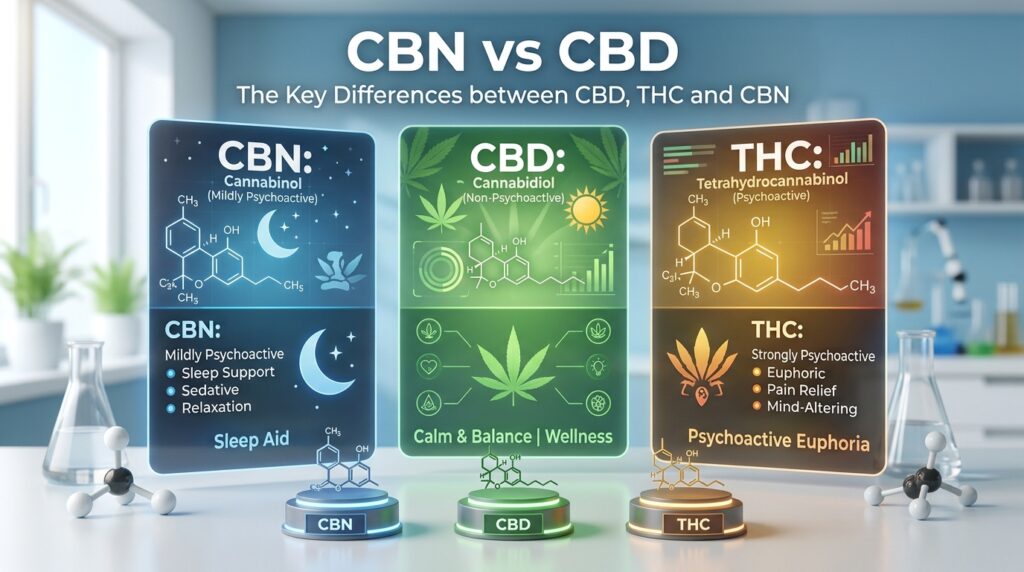
Where CBN And CBD Come From In The Hemp Plant and the Key Difference between CBD, CBN and THC.
Lets discuss the differences between CBN and CBD. CBD follows the route most cannabinoid charts show. The plant makes cannabigerolic acid, or CBGA. An enzyme turns that into cannabidiolic acid, or CBDA. Heat drives off a carbon dioxide molecule. What is left is the CBD on the label.
CBN has no enzyme of its own. It shows up when delta-9 THC oxidises. A 2026 stability study tracked cannabinoids in plant material, extracts, oils and isolates at three storage temperatures. For most of the products tested, room temperature accelerated the degradation of THC into cannabinol. Storage at minus 20°C kept the original profile.
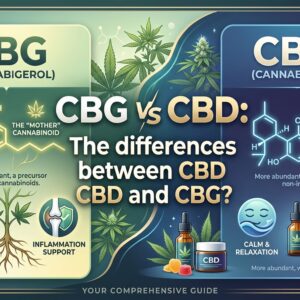
We cover the CBG side of the same family in how CBG compares with CBD.
Does CBN have Psychoactive Effects?
CBN comes from THC, so the question is a fair one. THC is the cannabinoid behind the high. CBN is not THC, though. It is a separate molecule with a separate structure.
Neither CBD nor CBN is intoxicating. Both get labelled non-psychoactive across the trade, though non-intoxicating is the more exact word for either one. The intoxicating effects of THC come from THC itself. A hemp oil label lists its delta-9 THC figure on its own line, and that is the number to read.
CBD and THC are separate compounds too. A lab panel gives each one its own row, so CBD vs CBN vs THC is a question the paperwork answers.
CBN vs. CBD: Understanding Potential Side Effects
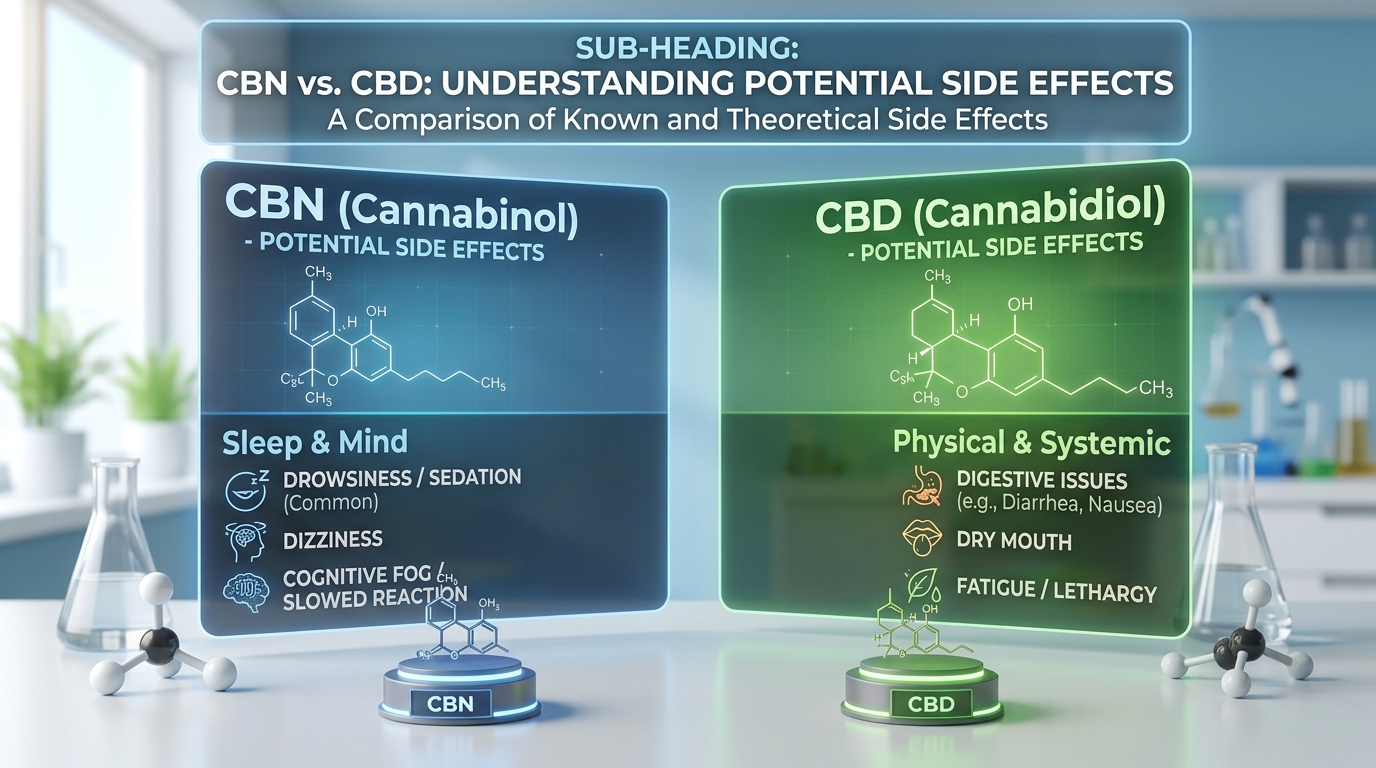
As more people explore hemp-derived products, many want to compare CBN and CBD and understand how each may affect the body. While research on cannabinoids like CBD and THC has grown in recent years, CBN is still considered a minor cannabinoid with far fewer studies behind it. CBN forms naturally as THC ages and breaks down, so its profile differs somewhat from CBD. Early reports on the effects of CBN suggest that CBN may cause drowsiness, grogginess, or lightheadedness in some individuals, especially at higher servings. Because CBN is loosely related to THC, it may also be mildly psychoactive for some people, although it is generally considered far less intoxicating. Individual experiences can vary based on body chemistry, product quality, and serving size.
The effect of CBD has been studied more extensively, which gives consumers a clearer picture of potential side effects. CBD may cause drowsiness, fatigue, diarrhea, dry mouth, or changes in appetite, and in some cases it has been associated with changes in liver enzyme levels. CBD may also interact with certain prescription medications, and CBN may carry similar interaction risks, though more research is needed to confirm this. Choosing products with third-party lab testing can also help verify cannabinoid content and purity.
Why Storage Matters More For THC Than CBD
The same 2026 study drew a sharp line between the two compounds. CBD-only products showed robust long-term stability, even at room temperature. THC-rich material was far more open to breaking down in warm air. It held its profile best as an ethanolic solution in a freezer.
So two bottles of the same strength are not the same object on a shelf. It is also worth keeping two questions apart. How CBN arises in stored material is one thing. What a finished bottle holds is another. Both our CBN oils state their contents as pure CBN isolate. That is a claim about purity, and a batch certificate is the paper that settles it.
What The Label Shows On CBD And CBN Products
Label strength rewards a little arithmetic. CBD products and CBN products are both sold this way, and the two CBN bottles show why it matters.
The 9,000mg CBN oil states 9,000mg of pure CBN isolate in a 1oz/30ml bottle. Its page breaks that down as 300mg per ml and 15mg from every drop, with THC non-detectable. The liposomal bottle carries the same 9,000mg headline in 60ml. Its page gives 150mg per ml and 7.5mg per drop.
Same total. Half the figure per drop. The total describes the bottle. The per millilitre figure describes the liquid. The per drop figure describes what a dropper hands you. Two products can share a headline number and still differ twofold in one drop. So comparing totals across different bottle sizes compares the packaging as much as the contents.
Why You Will See The Endocannabinoid System Mentioned
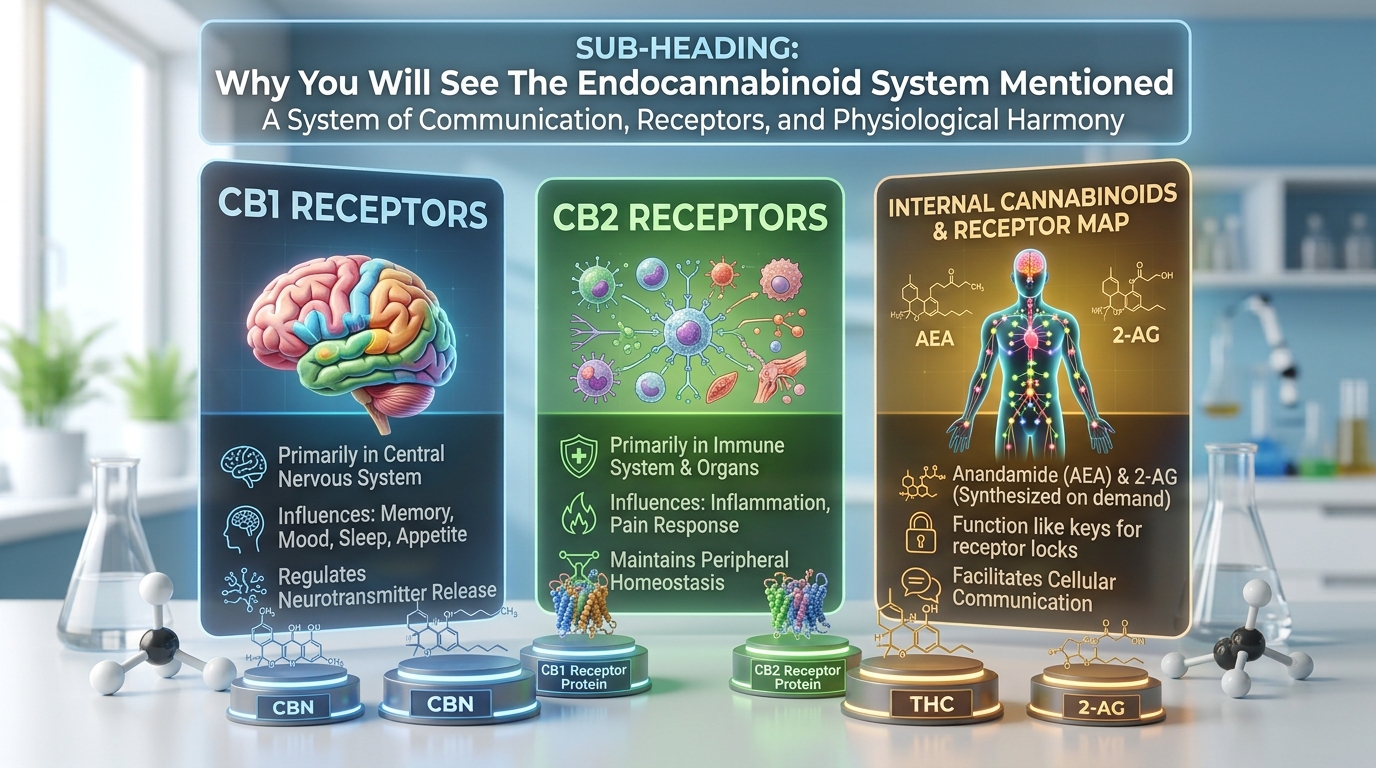
Read around CBD or CBN for long and you will meet this term. It is worth knowing what it covers, and what it does not.
The body has a cannabinoid system of its own. Researchers call it the body’s endocannabinoid system. A 2008 review splits it into three parts. There are the body’s own cannabinoids. There are the receptors in your body that they interact with. And there are the enzymes that build and break them down.
That review sets out where the CB1 and CB2 receptors sit. CB1 is present in high numbers in several brain regions. CB2 has a narrower spread, and turns up in a number of immune cells.
Now the part the term is often used to skip over. That research describes the body. It does not say what a hemp oil does once you take it. A certificate can tell you what is in a bottle. Nothing on this page can tell you what it will do, and no seller can honestly tell you either. That is why this page stays on the label and the paperwork.
What “Liposomal” Should Mean On A Label
Both cannabinoids also come in liposomal form. That describes the delivery format, not the molecule. The wrapping step works the same way for either one, and we have written up how liposomal encapsulation works on its own page.
On its own, though, the word carries no number. FDA guidance on liposome drug products lists the properties a maker should measure. Two of them pin the format down: particle size, as a mean and a distribution profile, and encapsulation efficiency. That second one means how much sits inside the liposomes against how much is there in total.
That guidance covers new drug applications. It does not apply to a hemp oil, and a hemp oil is not a drug. But it is a fair test of what would turn “liposomal” from an adjective into a spec: a diameter, a spread, and a percentage.
By that test, our own pages come up short. We checked all four liposomal oils on 14 September 2026. Not one of them publishes a mean particle size, a size spread, or an encapsulation efficiency figure. Each page describes a phospholipid bilayer. None gives a diameter. That is a gap in what we publish. We are stating it here rather than papering over it, because it is the honest answer to anyone comparing two liposomal labels.
Where the Cannabinoid CBD and CBN Stands With The FDA
One gap between the two is worth stating plainly. CBD is the active ingredient in a prescription medicine. The FDA approved Epidiolex, a purified CBD drug substance, for seizures tied to Lennox-Gastaut syndrome and Dravet syndrome. CBN is in no approved product at all. Beyond Epidiolex and two synthetic THC medicines, the agency says that no cannabis-derived product has been approved as safe and effective in any patient population.
That is a fact about drug review. It says nothing about a bottle of hemp oil. It sits here because the gap is real, and anyone comparing the two molecules will meet it sooner or later.
Compare CBN vs CBD On Paper
Stripped back, the difference is one of origin. The plant makes CBD, and CBD keeps well at room temperature. CBN is mostly what THC becomes when it is left in the air. Everything else worth comparing sits on the label or the certificate. Milligrams per drop. THC content. Whether anyone has published a particle size.
To read the two formats side by side, try the CBN oil range.
The liposomal numbers, and the gap described above, are on the liposomal CBN product page.
These statements have not been evaluated by the Food and Drug Administration. This product is not intended to diagnose, treat, cure or prevent any disease. If you are pregnant or nursing, speak with your healthcare provider before use.
Going Deeper: Sources And Further Reading
The stability study. Majumdar and colleagues published it in Cannabis and Cannabinoid Research in 2026. The record is PMID 42576671. The work came out of the National Center for Natural Products Research at the University of Mississippi. They held plant material, extracts, oil formulations and isolates at room temperature, in a fridge and in a freezer. They measured cannabinoid content by gas chromatography. Two findings carry the article above. Room temperature sped up the change from THC to CBN. CBD-only products stayed stable long-term even at room temperature.
The FDA liposome guidance. Its full title is Liposome Drug Products: Chemistry, Manufacturing, and Controls; Human Pharmacokinetics and Bioavailability; and Labeling Documentation. CDER issued it in April 2018. It carries nonbinding recommendations. Item (f) of its physicochemical list is “Particle size (i.e., mean and distribution profile)”. Item (e) covers “drug encapsulation efficiency”. The guidance also counts particle size and size spread among the critical quality attributes.
The receptor work. Mackie’s 2008 review in the Journal of Neuroendocrinology is PMID 18426493. It sets out the endocannabinoid system and the CB1 and CB2 receptors. Both are G protein-coupled receptors. The review notes that other receptors may play a part too.
The CBG comparison. CBG is the third cannabinoid people line up against CBD, and it comes from a third route again. That one is a scarcity story rather than a breakdown story.
Our own numbers. Product strengths come from the product pages. No certificate figure appears in the copy above, because certificates rotate with each batch.
Educational and Regulatory Disclaimer
This article is for educational and informational purposes only and is not medical advice. It does not recommend a dose or claim that a dietary supplement or CBD product diagnoses, treats, cures, mitigates, or prevents any disease. Dietary-supplement structure/function and general-well-being claims must be truthful, non-misleading, and substantiated; a disclaimer does not replace adequate evidence.3 Consult a qualified healthcare professional before using a dietary supplement, especially if you are pregnant or nursing, take medication, have a medical condition, or are considering a high dose.
These statements have not been evaluated by the Food and Drug Administration. This product is not intended to diagnose, treat, cure, or prevent any disease.