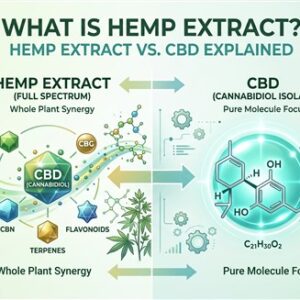


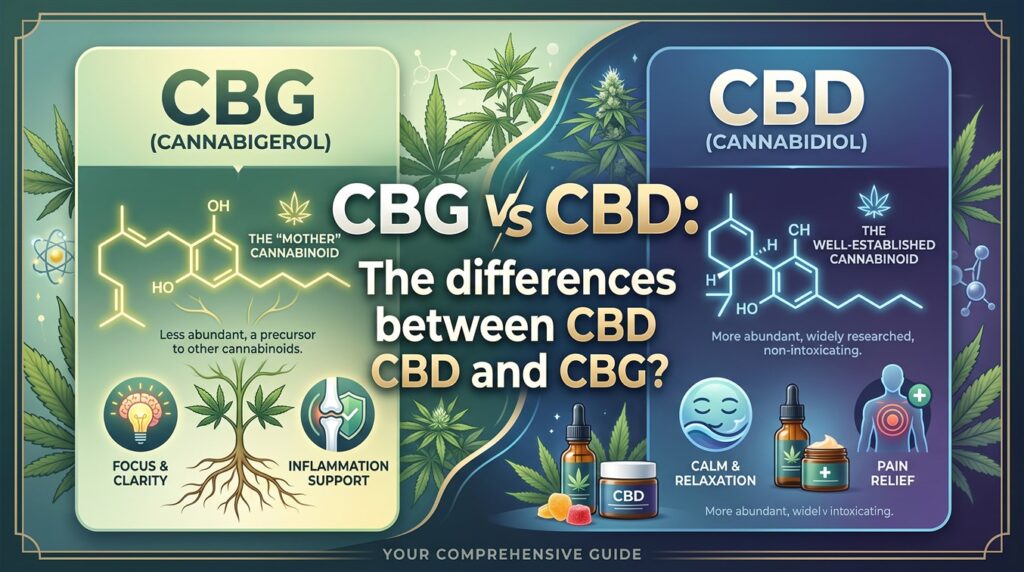
CBG and CBD are two cannabinoids. Both come from the same hemp plant. Both show up on the same lab report. Past that point they part ways. The plant makes far more CBD than CBG. CBG costs more to get out. A batch certificate shows the gap in plain numbers.
This page sets out the key differences between CBD and CBG, and where each one comes from.
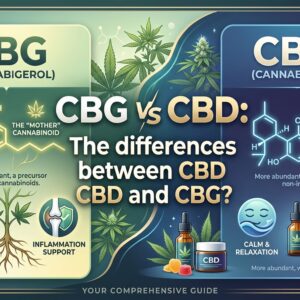
CBG vs CBD: The Key differences between CBD or CBG
Here are the short answers.
CBD stands for cannabidiol. CBG stands for cannabigerol. Both are cannabinoids, and the hemp plant makes both. CBG like CBD falls under the 2018 farm bill act if THC levels remain at less than 0.3% making it federally legal but check local State laws.
CBD is the one hemp makes most of. CBG is the one it makes least of. Neither is intoxicating. THC is the cannabinoid that does that, and a hemp plant holds very little of it.
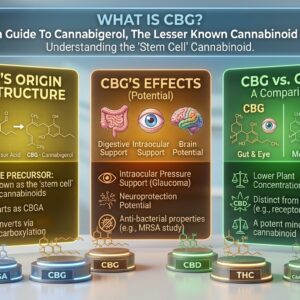
CBG is also the parent compound. The plant turns it into other cannabinoids as the flower grows. CBD is one of those. So CBG comes first in the plant and last in the bottle.
So a choice of CBD or CBG is not a choice about quality. It is a choice about which cannabinoid the bottle leads with, and what that costs.
Where CBD and CBG Come From In The Cannabis Plant
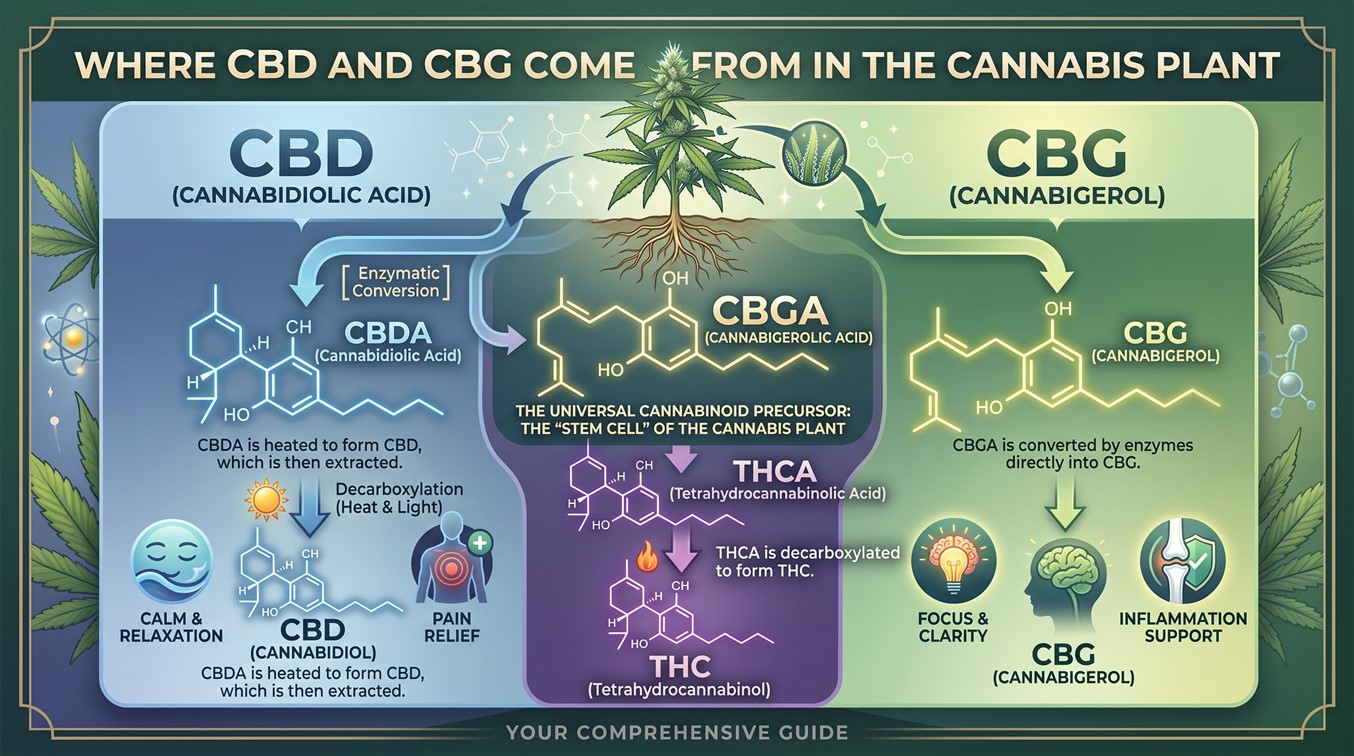
Both start as one acid. Its name is cannabigerolic acid, or CBGA.
As the plant grows, enzymes turn CBGA into other acids. One of them is CBDA. Heat then drives off a carbon dioxide molecule. CBDA becomes CBD. Any CBGA the plant did not convert becomes CBG. That is the whole split, in four steps.
Three enzymes do most of this work. A 2026 paper mapped their shapes. It calls them the major cannabinoid synthase enzymes acting on a common CBGA precursor. The same paper notes that the three share much of their structure. More on that in the reading list at the end.
CBD vs CBG: Why CBG Costs More
The math follows from the chemistry. CBGA is the input, not the output. By harvest, the plant has spent most of it. What is left is the remainder.
A grower who wants CBG has two routes. One is to cut the crop early, before the enzymes finish. That means a smaller flower. The other is to plant a cultivar bred to convert less CBGA. That narrows the seed choice a lot. Both routes cost yield. So CBG extract has long cost more than CBD extract across the trade. Research on CBG has to work around the same scarcity.
CBD sits at the other end of that trade. A normal hemp cultivar turns most of its CBGA into CBDA. One harvest fills a whole product line. You can see the result in our CBD oil selection, where the same hemp-derived CBD runs across several strengths and formats. Most CBD products on the market come from that kind of harvest.
Will CBG Or CBD Get You High like THC?
No. Neither one will cause a high. CBG is non-intoxicating and so is CBD. Both get labelled non-psychoactive across the trade, though non-intoxicating is the more exact word for either one. THC is the cannabinoid behind the intoxicating effects of cannabis, and federal rules cap how much of it a hemp plant may carry.
CBD and CBG are different molecules from psychoactive THC. CBD and THC are not the same compound, and a lab panel lists them on separate lines. A full-spectrum hemp oil does hold a trace of THC. The report gives that figure, so you can read it rather than guess at it.
Side Effects of CBD vs. CBG
CBD and CBG are both non-intoxicating cannabinoids found in the hemp plant, and many people want to know how their potential side effects compare. Research on CBD is far more extensive, since it has been widely studied over the past decade, while CBG is still considered a minor cannabinoid with a smaller body of research. CBG is often called the “mother cannabinoid” because other cannabinoids, including CBD and THC, form from its acidic precursor as the plant matures. Unlike THC, neither CBD nor CBG is known to produce psychoactive effects, and federally compliant hemp products must contain less than 0.3% delta-9 THC by dry weight. Early user reports suggest CBG may cause mild side effects such as dry mouth, drowsiness, changes in appetite, or digestive discomfort in some individuals.
Research on CBD has identified side effects that may include fatigue, drowsiness, diarrhea, dry mouth, and changes in appetite, and in some cases CBD has been associated with changes in liver enzyme levels. CBD may also interact with certain prescription medications, and CBG may carry similar interaction risks, although more research is needed to confirm this. Because CBG is often used alongside CBD in full-spectrum and broad-spectrum formulas, it can be difficult to tell which cannabinoid is responsible for a particular effect. People who take CBG alongside CBD may notice different results than with either cannabinoid alone, and individual experiences can vary based on body chemistry, product quality, and serving size.
Why You Will See The Endocannabinoid System Mentioned
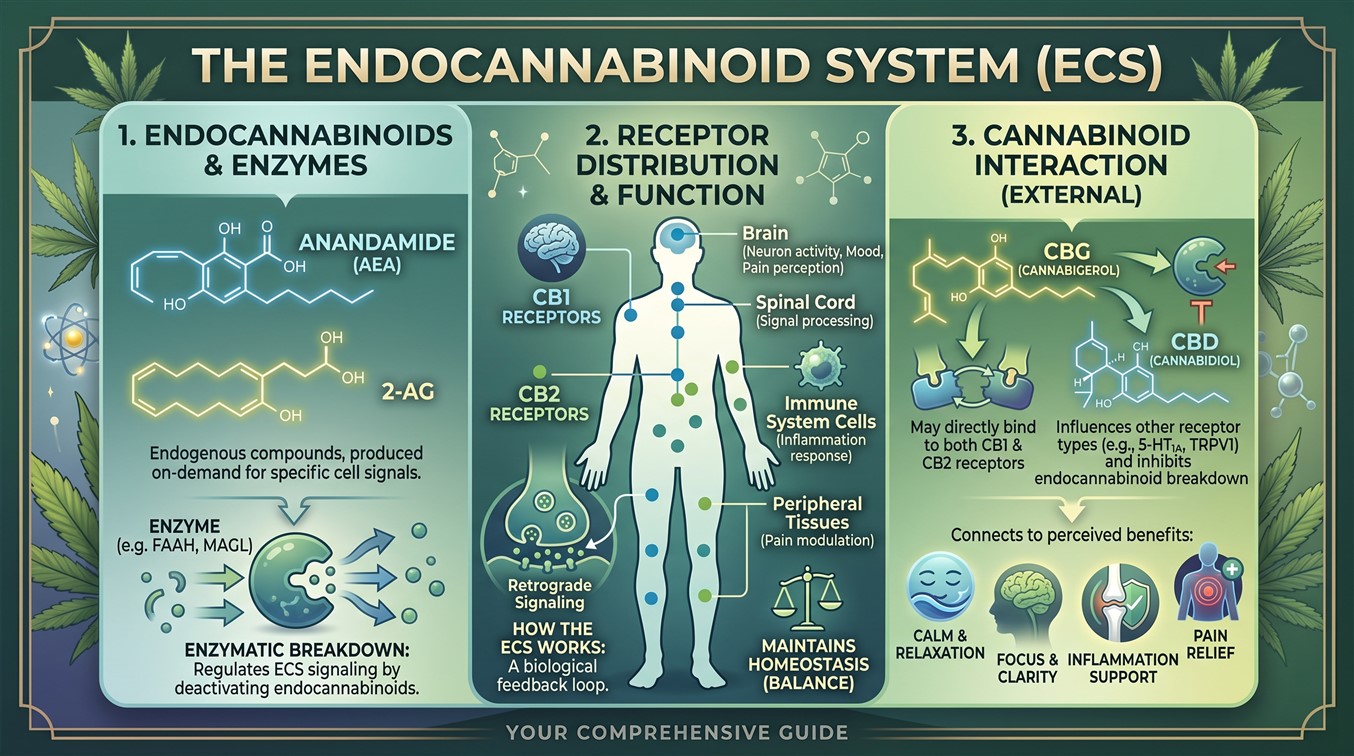
Read around CBD or CBG for long and you will meet this term. It is worth knowing what it covers, and what it does not.
The body has a cannabinoid system of its own. Researchers call it the body’s endocannabinoid system. A 2008 review describes it in three parts. There are the body’s own cannabinoids. There are the receptors they interact with. And there are the enzymes that build and break them down.
That same review sets out where the CB1 and CB2 receptors sit. CB1 is present in high numbers in several brain regions. CB2 has a narrower spread, and turns up in a number of immune cells.
Now the part the term is often used to skip over. That research describes the body. It does not say what a hemp oil does once you take it. A certificate can tell you what is in a bottle. Nothing on this page can tell you what it will do, and no seller can honestly tell you either. That is why this page stays on the label and the paperwork.
Full-Spectrum Oil Holds Both Cannabinoids
CBG and CBD are not rivals. A full-spectrum extract from a normal hemp cultivar holds both, because the plant made both. The certificate lists them both, including CBD and CBG on their own separate lines.
CBG products sold as CBG-forward come from material where the ratio runs the other way. So a choice between the two is a choice about ratio and price. It is not a choice about whether one molecule is there at all.
Delivery format is a separate question. Liposomal oils wrap the oil before bottling. That is a making step, not a change to the molecule. We cover it in our notes on liposomal CBD oil.
What A Batch Certificate Shows
A certificate of analysis is a lab paper about one run of material. An outside lab issues it, not us. That split is the point of the document.
The paper lists each cannabinoid on its own line, by weight and as a percent. A full-spectrum oil shows a row for CBD, a row for CBG, rows for the minor cannabinoids, and a delta-9 THC figure. Screens for solvent, heavy metals and pesticides usually sit alongside. Each screen reports against the lab’s detection limit, not as a plain yes or no.
Every certificate carries a batch number. That number ties one bottle to one test. A certificate for another batch covers another run of material. So the number matters more than the product name does.
Ours sit in the product gallery images, beside the item they describe. SC Labs issued the one for our 9,000mg full spectrum oil on 3 December 2025, under sample ID 251202L012. It reports a CBG figure and a CBD figure for the same bottle, from one analysis.
Compare The Two On Paper
So the short version is this. CBG and CBD start in the same place. The plant splits them apart. Price follows scarcity. The certificate settles which is which.
To read them side by side, the CBG oil collection lists the CBG-forward oils next to the CBD ones.
These statements have not been evaluated by the Food and Drug Administration. This product is not intended to diagnose, treat, cure or prevent any disease. If you are pregnant or nursing, speak with your healthcare provider before use.
Going Deeper: Sources And Further Reading
The enzyme work. Domenech and colleagues mapped three enzyme structures in 2026, in Current Research in Structural Biology. The record is PMID 42502799. They name CBCAS, CBDAS and THCAS as the main cannabinoid synthase enzymes. All three act on CBGA. The three share high degrees of homology. So their different jobs come from small changes in sequence and shape, not from different machinery. The paper shows each one bound to its FAD coenzyme.
The receptor work. Mackie’s 2008 review in the Journal of Neuroendocrinology is PMID 18426493. It sets out the endocannabinoid system and the CB1 and CB2 receptors. It also notes that other receptors may play a part. CB1 and CB2 are both G protein-coupled receptors.
The federal position. The FDA lists which cannabis-derived drugs it has approved. The list is short. It sets this out in its questions and answers on cannabis.
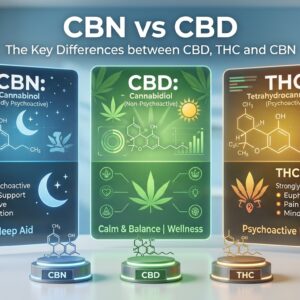
The CBN comparison. CBN is the third cannabinoid people line up against CBD. It comes from a different route again. We cover that in how CBN compares with CBD.
Educational and Regulatory Disclaimer
This article is for educational and informational purposes only and is not medical advice. It does not recommend a dose or claim that a dietary supplement or CBD product diagnoses, treats, cures, mitigates, or prevents any disease. Dietary-supplement structure/function and general-well-being claims must be truthful, non-misleading, and substantiated; a disclaimer does not replace adequate evidence.3 Consult a qualified healthcare professional before using a dietary supplement, especially if you are pregnant or nursing, take medication, have a medical condition, or are considering a high dose.
These statements have not been evaluated by the Food and Drug Administration. This product is not intended to diagnose, treat, cure, or prevent any disease.