

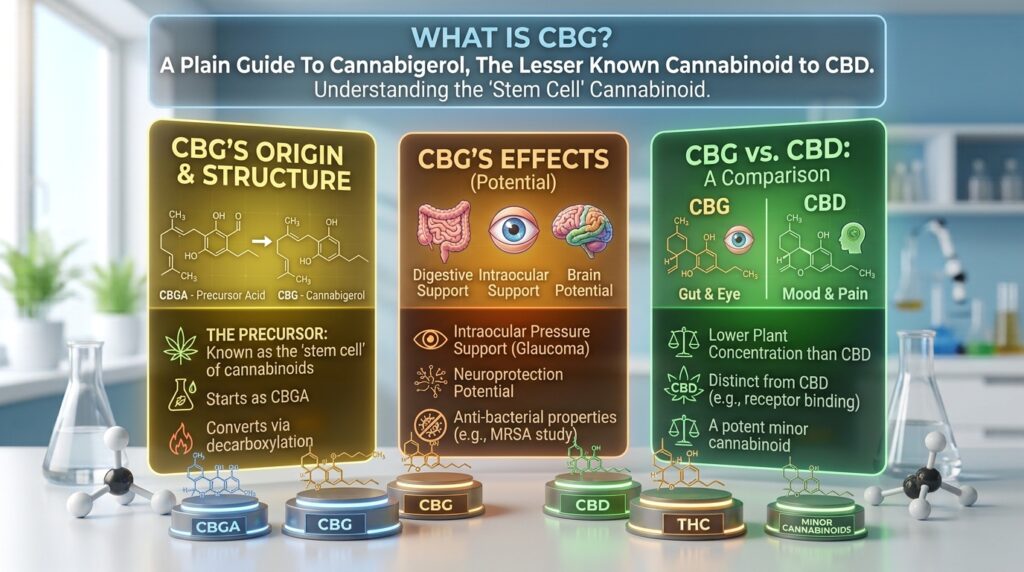
CBG is a cannabinoid, a compound hemp makes before the plant makes anything else. Most bottles lead with THC and CBD. CBG rarely gets the headline. Every one of those other cannabinoids starts out as CBG.
This page stays on the plant chemistry and the label. It explains what CBG is. It explains where CBG sits in the plant. And it explains what a bottle called “CBG oil” actually contains.
What CBG Stands For
CBG stands for cannabigerol, the same way CBD stands for cannabidiol. Both are cannabinoids found in the cannabis plant, Cannabis sativa, out of well over a hundred identified so far. Hemp is a low-THC form of that same plant. It gets grown for fiber, for seed, or for its cannabinoid content.
CBG shows up on the same lab panel as CBD, CBN, and THC. A full lab report lists each one on its own row. Anyone comparing CBD and THC content will find a CBG row on the same page. CBG is usually the smallest row. The plant carries the least of it by harvest time.
CBGA: Where the Cannabinoid CBG Comes From In The Plant
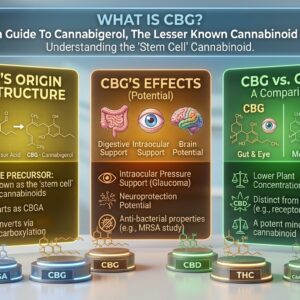
Every one of those cannabinoids starts from one acid. Its name is cannabigerolic acid, or CBGA. As the plant grows, three enzymes act on that one molecule. They turn it into three different acids: CBDA, THCA, and CBCA. Heat then converts each acid into the cannabinoid a label names. CBG and THC start at that same branch point before splitting apart.
CBGA is the parent cannabinoid in that whole chain, the precursor every other one starts from. The trade sometimes calls CBG the mother of all cannabinoids for this reason — a name about the order acids form in a plant, not about anything a bottle does once it’s in a person. Many other cannabinoids besides CBD, THC, and CBC trace back to the same acid. A 2026 study solved the shape of the three enzymes that do this work. It calls them the cannabinoid synthases CBCAS, CBDAS, and THCAS. All three share most of their structure. Small differences in one part decide which acid comes out. Whatever CBGA the plant leaves unconverted by harvest becomes the CBG a lab reports. A cultivar bred to convert less CBGA could narrow that gap, and breeders are working on exactly that.
CBG And CBD: Are They The Same Molecule?
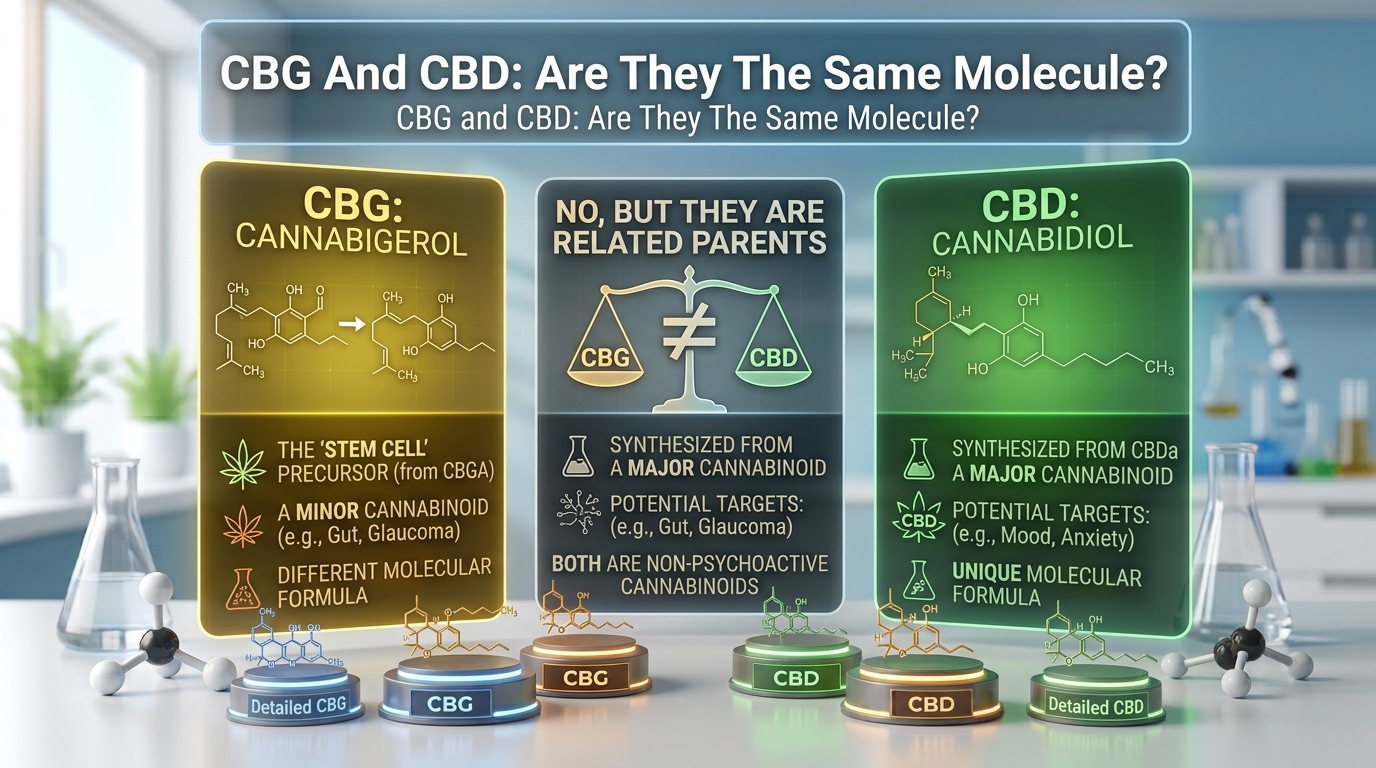
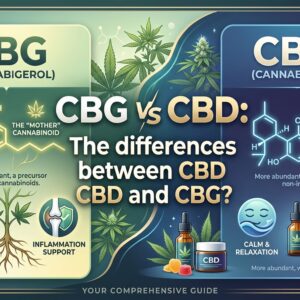
No. CBG vs CBD comes down to one enzyme. They share a starting point. They do not share a structure. CBGA gives rise to both. But an enzyme changes CBGA into CBDA first. That step never touches CBG. Once the split happens, CBG and CBD are not the same molecule again.
That split is the whole subject of our full comparison between CBG and CBD. It sets the two side by side on cost, on ratio, and on what a certificate shows for each.
Is CBG Psychoactive? Will It Get You High?
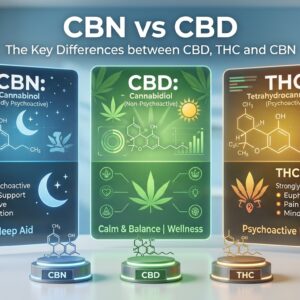
No. CBG is non-intoxicating, and so is CBD. THC is the cannabinoid behind a cannabis high, through its strong grip on a receptor called CB1. Unlike THC, CBG does not grip CB1 tightly. A 2018 study measured how CBG binds the body’s two main cannabinoid receptors, CB1 and CB2. The study found that CBG binds weak at the CB1 receptor. Its grip there measured far lower than at CB2. At CB2, the same study found CBG acting as a partial agonist. That means CBG engages the receptor. It just does not switch it fully on.
That pattern is why the trade calls CBG non-psychoactive, alongside CBD, though non-intoxicating is the more exact word. THC’s strong grip on CB1 is what an intoxicating cannabinoid needs. CBG does not have it.
CBG And The Endocannabinoid System
Read around CBG for long and you will meet this term. It is worth knowing what it names, and what it does not.
Researchers call it the human body’s endocannabinoid system. It runs through the nervous system and beyond. A 2008 review splits it into three parts: the endocannabinoids themselves, the receptors in the body they interact with, and the enzymes that build and break them down.
That review sets out where the cannabinoid CB1 and CB2 receptors sit. CB1 is present in high numbers in several brain regions. CB2 has a narrower spread, mostly in a number of immune cells. CBG interacts with both, at levels far below THC’s.
This is research about the body, not about a bottle. A certificate can tell you what a bottle contains. Nothing on this page can tell you what it does once you take it, and no seller can honestly tell you either.
Why Cannabigerol CBG Costs More To Produce than CBD
The chemistry sets the price. CBGA is an input. The plant spends it down as it grows. It is not a stockpile the plant keeps. By harvest, most of the CBGA a plant made has already turned into something else.
A grower who wants CBG has two paths. One is an early harvest, before the conversion finishes. The other is a cultivar bred to convert less CBGA in the first place. Both trade away yield. That is why our standard-strength CBG oil rarely shares a price with its CBD counterparts.
The same scarcity runs through the science. Research on CBG is still thinner than research on CBD or THC, for the plain reason that there has always been less CBG to study.
What CBG Products Actually Contain
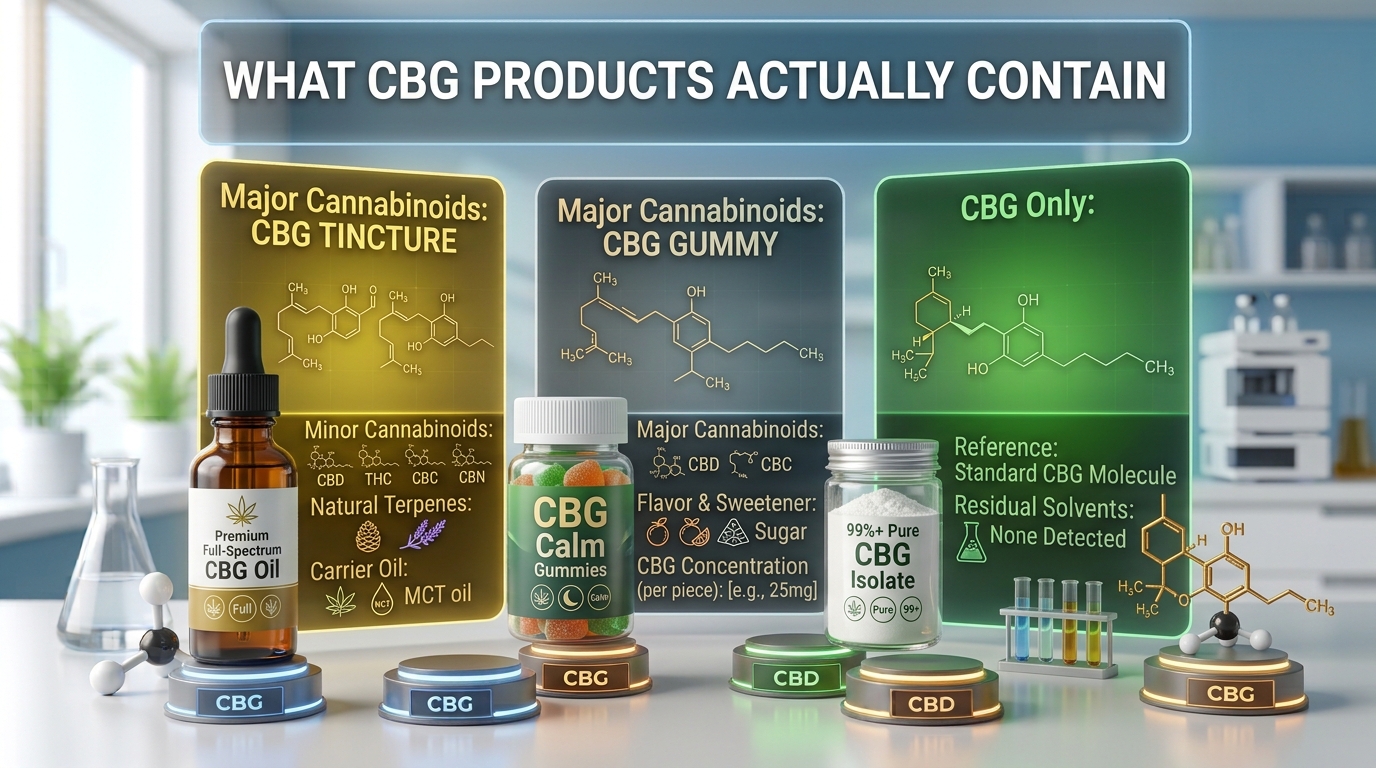
A label calling itself “CBG oil” is worth a close read. The name says which cannabinoid leads. It does not say which one stands alone. We checked our own two CBG products against their own pages. The standard 9,000mg bottle names CBG as the lead cannabinoid in a full spectrum formula. It also lists unnamed “naturally occurring cannabinoids.” The liposomal version goes further. It names CBD and CBC on the same page.
Neither page gives a percentage split between CBG and the rest of the formula. So the liposomal bottle is still a full spectrum extract, not an isolate. Reading past the front label to what the page actually names is the only way to know that.
Full spectrum is one of three common labels on a cannabinoid product. Broad spectrum keeps most of the same compounds after taking THC out. An isolate strips every cannabinoid down to one. Some sellers use the term entourage effect for the mix of cannabinoids and terpenes a full or broad spectrum extract carries. Researchers use that term to describe a combination, not a result, and no certificate can put a number on one.
How To Read A CBG or CBD Label
A CBG label reads similar to CBD: drops, milligrams, and a batch number. Three numbers do the real work. A total milligram figure describes the whole bottle. A milligram-per-millilitre figure describes the liquid. A milligram-per-drop figure describes what one dropper hands you. Two bottles can share a total figure and still differ by half in what one drop gives. Our own standard and liposomal CBG oils do exactly that.
A batch number matters more than any of those three. It ties one bottle to one certificate of analysis. An outside lab issues that certificate, not the seller. Any cannabinoid breakdown by percentage would appear on that paper, not on the front label.
Where CBG Stands With The FDA
CBD is the active ingredient in an approved prescription drug, Epidiolex. CBG is not. Beyond Epidiolex and two synthetic THC medicines, the FDA states plainly that no other cannabis-derived product has been approved as safe and effective in any patient population. That covers CBG along with every other cannabinoid outside that short list.
That is a fact about drug review. It is not a statement about a bottle of hemp oil. It sits here because it answers a question anyone comparing CBD and CBG will ask sooner or later.
What This Means For A Shopper
CBG is the cannabinoid a hemp plant makes first. The plant keeps the least of it by harvest. CBG shares an origin with CBD and CBN. It does not share their structure. It does not bind CB1 the way THC does. And a bottle sold as “CBG oil” is ordinarily a full spectrum extract led by CBG, not a single isolated molecule. The certificate settles the rest.
To compare bottles side by side, the current CBG oil lineup lists both formats with their batch paperwork.
These statements have not been evaluated by the Food and Drug Administration. This product is not intended to diagnose, treat, cure or prevent any disease. If you are pregnant or nursing, speak with your healthcare provider before use.
Conclusion
In short, CBG is another cannabinoid that starts as CBGA in the hemp plant. That place early in the cannabinoid pathway is why CBG is sometimes called the mother of all cannabinoids. By harvest, little CBGA is left unconverted, which helps explain CBG’s scarcity and why a bottle labelled “CBG oil” may still contain a full-spectrum mix of cannabinoids. The label, batch number, and certificate of analysis remain the clearest records of what a specific bottle contains.
CBG might appear alongside CBD, CBC, and other cannabinoids in a hemp extract. The effects of cannabigerol remain a subject of scientific study, and research is needed to fully describe the compound beyond its plant chemistry, receptor data, and the product specifications reported for a given batch.
Going Deeper: Sources And Further Reading
The main text above stays plain on purpose. The detail sits here.
The enzyme work
A 2026 paper in Current Research in Structural Biology solved X-ray crystal structures for CBCAS, CBDAS, and THCAS. These are the three enzymes that convert CBGA into CBCA, CBDA, and THCA. All three share substantial structural homology. The paper resolves each one bound to its FAD cofactor. The THCAS structure came out at higher resolution than before. The authors point to active-site differences in the surrounding amino acids as the likely source of each enzyme’s different substrate preference.
The receptor work
Navarro and colleagues published Cannabigerol Action at Cannabinoid CB1 and CB2 Receptors and at CB1-CB2 Heteroreceptor Complexes in 2018, in Frontiers in Pharmacology, PMID 29977202. They used radiolabelled ligand-binding assays. They measured CBG’s affinity at CB1 and CB2 in parallel. Binding at CB2 in living cells returned a Ki of 152 nanomolar. CBG competed a CB2-selective ligand with a Ki of 2.7 micromolar. The same ligand needed over 30 micromolar at CB1. That gap sits behind the non-intoxicating classification cited above. Functional assays showed CBG acting as a partial agonist at CB2. Its action at CB1 was measurable. Its mechanism there stays unclear.
The endocannabinoid system
Mackie’s 2008 review, Cannabinoid receptors: where they are and what they do, in the Journal of Neuroendocrinology, PMID 18426493, sets out the endocannabinoid system in three parts: the endocannabinoids, the cannabinoid CB1 and CB2 receptors, and the enzymes that build and break the endocannabinoids down. It states that CB1 receptors sit in very high levels in several brain regions and mediate many of the psychoactive effects of cannabinoids generally. CB2 receptors have a more restricted distribution, mostly in immune cells and a few neurones. The review notes both couple mainly to inhibitory G proteins, and that other receptors may play a part too.
The federal position
The FDA’s cannabis question-and-answer page lists every cannabis-derived product it has approved. The list covers three drugs. It states that no other cannabis-derived product has cleared that bar, including any built on CBG.
The CBD comparison
CBD is the cannabinoid CBG gets compared against most. A normal hemp harvest converts most of its CBGA into CBD, not CBG. Our full write-up covers the ratio, the cost gap, and what a side-by-side certificate shows.
Educational and Regulatory Disclaimer
This article is for educational and informational purposes only and is not medical advice. It does not recommend a dose or claim that a dietary supplement or CBD product diagnoses, treats, cures, mitigates, or prevents any disease. Dietary-supplement structure/function and general-well-being claims must be truthful, non-misleading, and substantiated; a disclaimer does not replace adequate evidence.3 Consult a qualified healthcare professional before using a dietary supplement, especially if you are pregnant or nursing, take medication, have a medical condition, or are considering a high dose.
These statements have not been evaluated by the Food and Drug Administration. This product is not intended to diagnose, treat, cure, or prevent any disease.