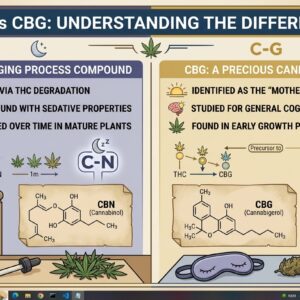


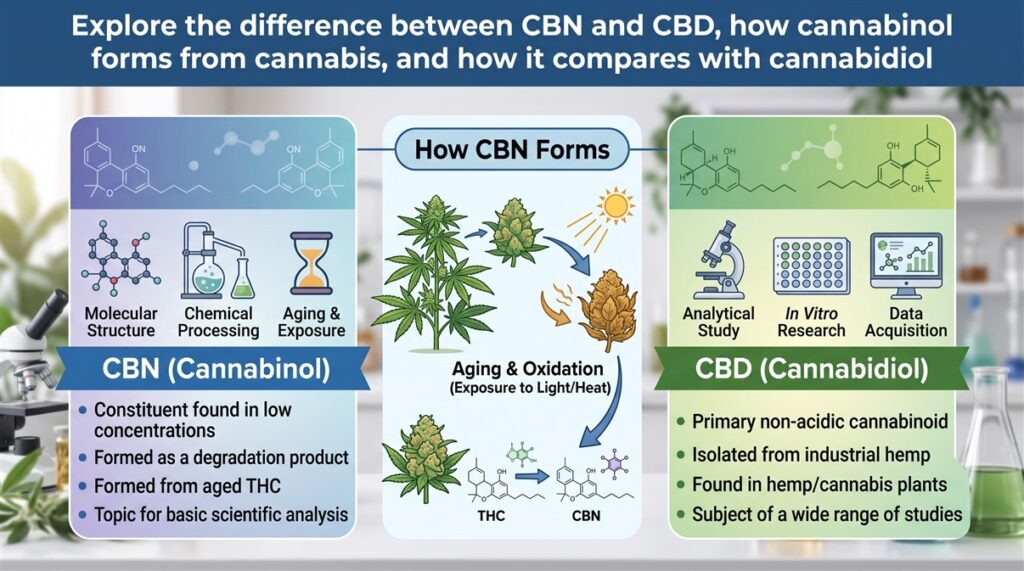
CBN turns up on more hemp labels every year. Most bottles do not explain it. CBN is a cannabinoid found in cannabis, but the plant does not set out to make it. It forms through oxidation, as THC changes over time.
This page stays on the chemistry and the label. It explains what CBN is, where CBN comes from, and how CBN differs from CBD. And it explains what a bottle called “CBN oil” actually contains.
Cannabinol, Cannabidiol, Tetrahydrocannabinol: What These Cannabinoid Names Mean
CBN stands for cannabinol. CBD stands for cannabidiol. THC stands for tetrahydrocannabinol. All three are compounds found in the cannabis plant, Cannabis sativa. Hemp is a low-THC form of that same plant. Growers raise the hemp plant for fiber, for seed, or for its cannabinoid content.
CBN shows up on the same lab panel as CBD, CBG, and THC. A full lab report lists each cannabinoid found in cannabis on its own row. Reading a CBN row next to a THC row is the fastest way to see how the two connect.
Every cannabinoid Hemp Therapies sells, including CBD, starts as a raw hemp extract before anything else happens to it. CBD products, CBG products, and CBN products all come from that same plant family.
Oils, Not Gummies: The CBN Products On This Site
Products containing CBN are not all built the same way. Some cannabis products list CBN as one line among several, alongside CBD or CBG. Across the industry, CBN shows up as oils, capsules, and gummies. Hemp Therapies’ own CBN products are two single-cannabinoid oils today, standard and liposomal. Its CBD products and CBD oil line are separate, listed under their own pages. Reading the full label on any of them, not just the format on the front, is the only way to know which kind you are holding.
The Slow Reaction That Turns THC Into CBN and effects of CBN.
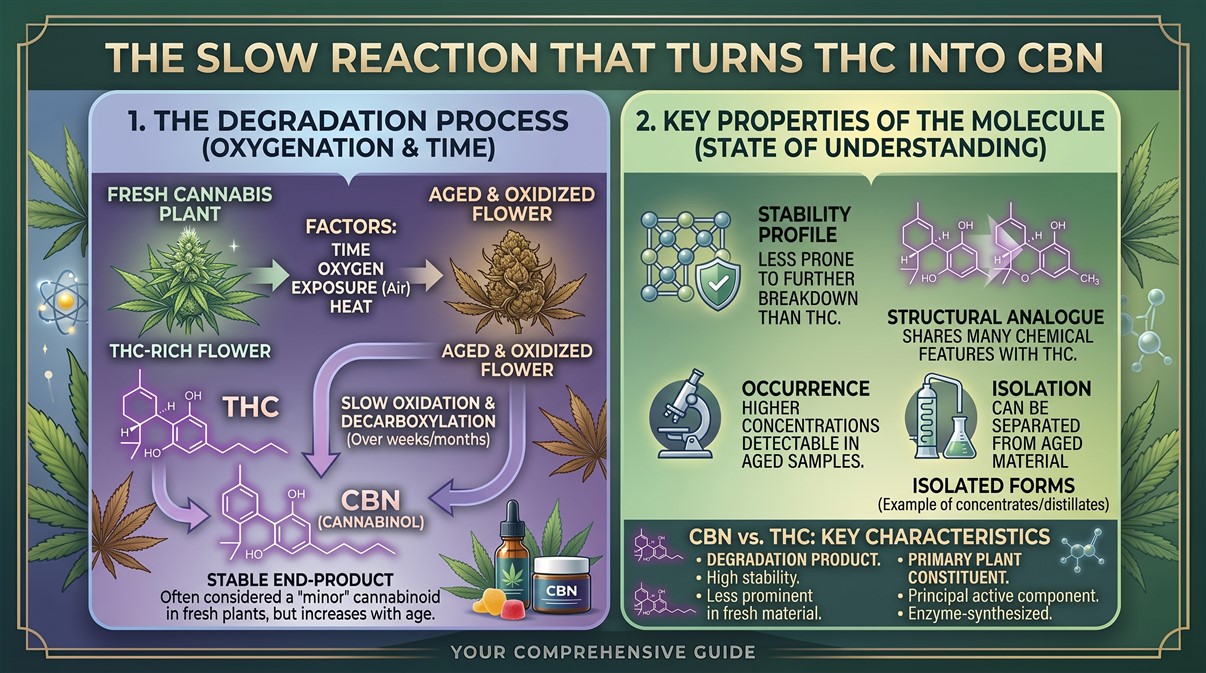
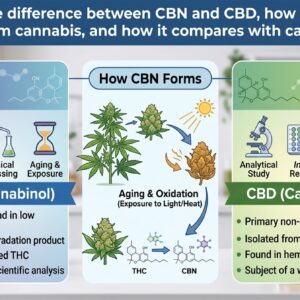
Most cannabinoids trace back to one parent acid the plant builds on purpose. CBN does not. THC forms CBN through a slow chemical change, not a dedicated enzyme. Once THC is exposed to warmth, light, and air, oxidation takes over. Some of that THC turns into CBN. Since CBN is created this way, and not grown, no two batches age the same way.
A 2026 study tracked cannabinoid levels in plant material, extracts, oils, and isolates, held at three different temperatures. Room temperature sped up the shift from THC into cannabinol. Storage at minus 20°C held the original profile in place. Levels of CBN in any given batch depend on its storage history, not on anything a grower plants for. Amounts of CBN can vary for that reason alone, long before a bottle is filled.
That single fact explains most of what makes CBN unusual. THC is the starting material. Time and light exposure decide how much of it becomes CBN, and no two batches age the same way. That is also where CBN parts ways from CBD.
One Sentence Separates CBN vs CBD
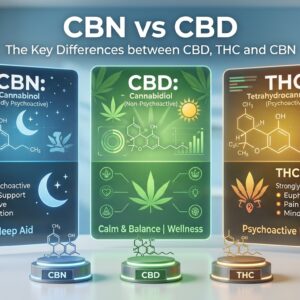
CBD comes from CBDA, a compound the plant builds directly. CBN comes from THC, after the fact. That is the whole difference between CBN and CBD in one line: one is a plant product, the other is a THC byproduct.
Whether you are weighing CBD or CBN, or CBD or THC, the same rule applies: read the certificate, not the marketing copy. CBD and CBN sit on the same lab panel but never in the same row, since each cannabinoid found in cannabis gets its own figure. CBD remains far more popular than CBN in the market today, mostly because CBD research has a decades-long head start. CBN research is newer and thinner by comparison. We cover the CBD side of this same plant family in full, including cost and ratio, in our full CBN vs CBD comparison.
The “Non-Psychoactive” Label, Tested Against The Data
This question does not have a clean yes-or-no answer, and the trade does not always say so.
THC is the cannabinoid behind a cannabis high, through its strong grip on the CB1 receptor. CBD and CBG bind CB1 weakly. CBN sits somewhere else on that scale. A 2025 review compared five major phytocannabinoids. It found that THC and cannabinol both show meaningfully greater affinity for CB1 and CB2 receptors than CBD does.
That finding complicates a common industry claim. The trade often calls CBN non-psychoactive, the same label used for CBD and CBG. A more accurate term, and one a growing number of pharmacology write-ups now use, is “mildly psychoactive” — a different effect than THC’s, not the absence of one. The pharmacology here is less settled than that label suggests.
None of this describes psychoactive effects a bottle produces once a person takes it. It describes how one molecule binds one receptor in a lab assay, at a level the review groups closer to THC’s than to CBD’s. Effects of CBN, effects of THC, and effects of CBD are three separate research questions, and this page only covers the receptor data, not any of the three.
Separately, both Hemp Therapies CBN oils list their own THC content as non-detectable, confirmed by third-party lab testing.
Endocannabinoid System: The Term You’ll Keep Meeting
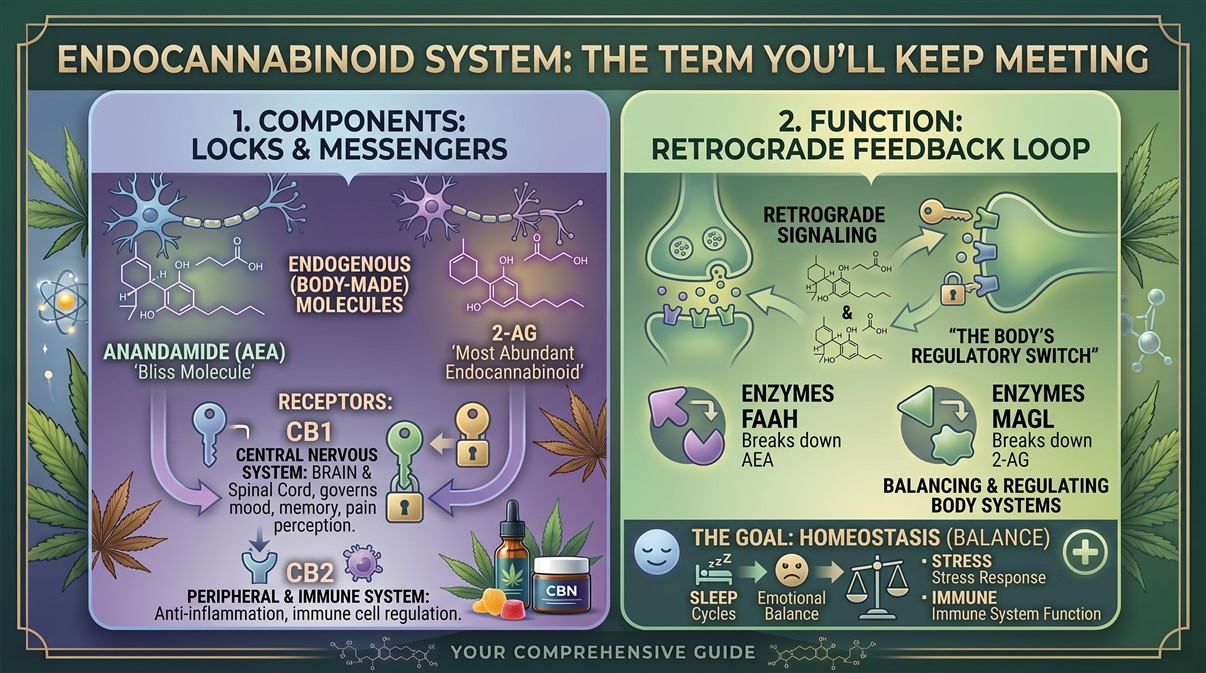
Read around CBN for long and you will meet this term. It is worth knowing what it names, and what it does not.
Researchers call it the human body’s endocannabinoid system. A 2008 review splits it into three parts. There are the endocannabinoids themselves. There are the receptors they interact with. And there are the enzymes that build and break them down. That review sets out where the CB1 and CB2 receptors sit. CB1 sits in high numbers in several brain regions. CB2 has a narrower spread, mostly in immune cells.
This is research about the body, not about a bottle. A certificate can tell you what a bottle contains. Nothing on this page can tell you what it does once you take it, and no seller can honestly tell you either.
Where Hemp Therapies Grows And Extracts Its Hemp
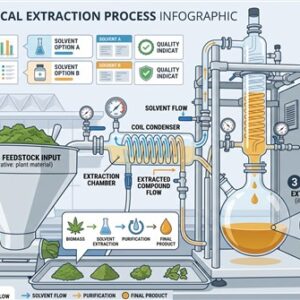
Every cannabinoid on a label starts as a plant, on a real piece of land. Cannabis and hemp are the same plant species, just different forms of it, and Hemp Therapies grows and processes its own hemp at a 200-acre facility in Long Beach, New York. The site runs both outdoor field cultivation and climate-controlled greenhouse growing. Extraction happens on site too, through CO2 extraction equipment, before the oil moves on to formulation and finishing.
That is the starting point for every bottle, not the finish line. A fresh CO2 extract reflects whatever cannabinoid profile the plant carried at harvest. Cannabinol forms afterward, through storage, not through anything that happens in the field or the extractor.
Three Numbers Worth Checking On Any CBN Label
A CBN label reads like a CBD label: drops, milligrams, and a batch number. Three figures do the real work. Total CBN per bottle, CBN per ml, and CBN per drop are what to compare, not the headline milligram figure alone.
Our standard-strength CBN oil states 9,000mg of pure CBN isolate in a 1oz/30ml bottle. That works out to 300mg per ml, 15mg per drop, with THC listed as non-detectable. The liposomal version carries the same 9,000mg headline. Its bottle holds 60ml, at 150mg per ml and 7.5mg per drop. Same total. Half the figure per drop. Two bottles can share a headline number and still hand you a different dose per drop.
Both product pages label the bottle pure CBN isolate. Neither page names another cannabinoid. That is a different formula than a full spectrum oil. A full spectrum extract keeps a wider mix of cannabinoids and terpenes alongside the lead compound. A batch number ties one bottle to one certificate of analysis, issued by an outside lab, not the seller. Any percentage breakdown sits on that paper, not on the front label.
The One FDA Fact That Actually Applies to CBN vs CBD
CBD is the active ingredient in an approved prescription drug, Epidiolex. CBN is not. Beyond Epidiolex, only two synthetic THC medicines carry FDA approval. The agency states: no other cannabis-derived product has been approved as safe and effective in any patient population. That covers CBN along with every cannabinoid outside that short list.
That is a fact about drug review. It says nothing about a bottle of hemp oil. It sits here because it answers a question anyone reading a CBN label will ask sooner or later.
What This Page Does Not Cover
This page does not give dosing guidance. It does not list doses of CBN, risks of CBN, or side effects of CBN. It does not tell you how to use CBN, why to use cannabinoids like CBN, or how much to use. Those are questions for a healthcare provider and a certificate of analysis, not a blog post, and no seller can honestly answer them for you either.
Read The Certificate, Not The Bottle
A front label tells a shopper what a bottle is called. A certificate tells them what is actually inside it, at what strength, and tested by whom. For CBN specifically, the certificate carries more weight than usual, since CBN’s own level in a batch depends on storage history, not on a fixed recipe. Choosing between CBD or CBN is not a question this page tries to answer — that depends on which molecule’s profile someone is after, not which one is “better.”
To see the current lineup side by side, our CBN oil lineup lists both formats with their batch paperwork.
These statements have not been evaluated by the Food and Drug Administration. This product is not intended to diagnose, treat, cure or prevent any disease. If you are pregnant or nursing, speak with your healthcare provider before use.
Going Deeper: Sources And Further Reading
The main text above stays plain on purpose. The detail sits here.
The stability study
Majumdar and colleagues published this work in Cannabis and Cannabinoid Research in 2026, PMID 42576671. The team works out of the National Center for Natural Products Research at the University of Mississippi. They held plant material, extracts, oil formulations, and isolates at room temperature, in a fridge, and in a freezer. They measured cannabinoid content by gas chromatography. Room temperature sped the shift from THC to CBN. CBD-only products stayed stable long-term even at room temperature.
The receptor-affinity review
Queiroz and colleagues published this review in Progress in Brain Research, 2025, volume 296, pages 1 to 28, PMID 40967679. Its title: Chemical diversity, receptor binding affinity, and pharmacology of phytocannabinoids: Insights into neuronal mechanisms. The review compares five phytocannabinoids — CBG, CBC, CBD, THC, and CBN — on structure, receptor binding, and pharmacology. It reports that THC and cannabinol both carry substantially greater affinity for CB1 and CB2 receptors. CBD and related compounds carry less. It points to GPR55, TRPV1, and TRPM8 as alternate targets for the cannabinoids that bind CB1 and CB2 weakly.
Endocannabinoid system, sourced
Mackie’s 2008 review is titled Cannabinoid receptors: where they are and what they do. It ran in the Journal of Neuroendocrinology, PMID 18426493. It sets out the endocannabinoid system in three parts. One: the endocannabinoids. Two: the CB1 and CB2 receptors. Three: the enzymes that build and break the endocannabinoids down. CB1 receptors sit in very high levels in several brain regions. CB2 receptors have a narrower distribution, mostly in immune cells.
Educational and Regulatory Disclaimer
This article is for educational and informational purposes only and is not medical advice. It does not recommend a dose or claim that a dietary supplement or CBD product diagnoses, treats, cures, mitigates, or prevents any disease. Dietary-supplement structure/function and general-well-being claims must be truthful, non-misleading, and substantiated; a disclaimer does not replace adequate evidence.3 Consult a qualified healthcare professional before using a dietary supplement, especially if you are pregnant or nursing, take medication, have a medical condition, or are considering a high dose.
These statements have not been evaluated by the Food and Drug Administration. This product is not intended to diagnose, treat, cure, or prevent any disease.