

You see the word “liposomal” on more labels every year. Vitamin C has it. Glutathione has it. So do some hemp oils. Most bottles never say what the word means.
This guide does. It covers what a liposome is and how liposomal delivery works. It shows how a liposomal formula differs from a standard one. And it lists what to check on the label before you buy.
What Does Liposomal Mean?
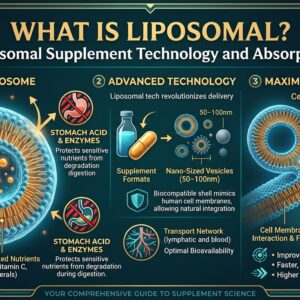
“Liposomal” means “made with liposomes.” The word comes from two Greek roots. “Lipo” means fat. “Soma” means body. A liposome is a tiny body made of fat.
So in a liposomal product, the main ingredient sits inside tiny fat spheres. The word names a delivery system. It tells you how the ingredient is packed. It tells you nothing about what the ingredient is.
That is the key point. Liposomal is a format, not an ingredient. Liposomal vitamin C is still vitamin C. It just comes wrapped in a different way.
What Is a Liposome?
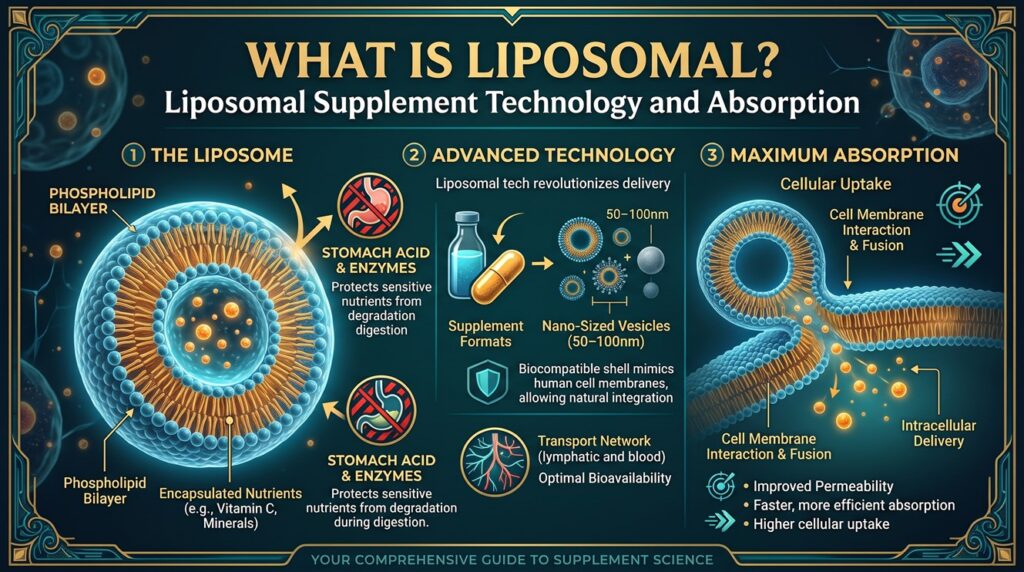
A liposome is a hollow ball with a wall made of fat molecules. Scientists first described them in the mid-1960s. A widely cited 2013 review defines liposomes as sphere-shaped vesicles made of one or more phospholipid bilayers. The same review notes that some liposome drugs are now in clinical use.
The phospholipid bilayer
A phospholipid is a fat molecule with two ends. The head likes water. The tail avoids it. Chemists call the head hydrophilic and the tail hydrophobic.
Drop phospholipids in water and they line up on their own. They form a double layer, with tails in and heads out. That double layer is the bilayer. When it curls into a closed ball, you get a liposome.
The same kind of bilayer forms the cell membrane in humans. That is why makers say liposomes are “made of the same stuff” as cells. Most commercial liposomes use soy lecithin and sunflower lecithin.
Two places to carry an ingredient
A liposome has two zones. The watery core holds things that mix with water, like vitamin C. The fatty wall holds oily things, like cannabinoids. That is why one format can carry such different compounds.
How Liposomal Delivery Works Compared to Traditional supplements
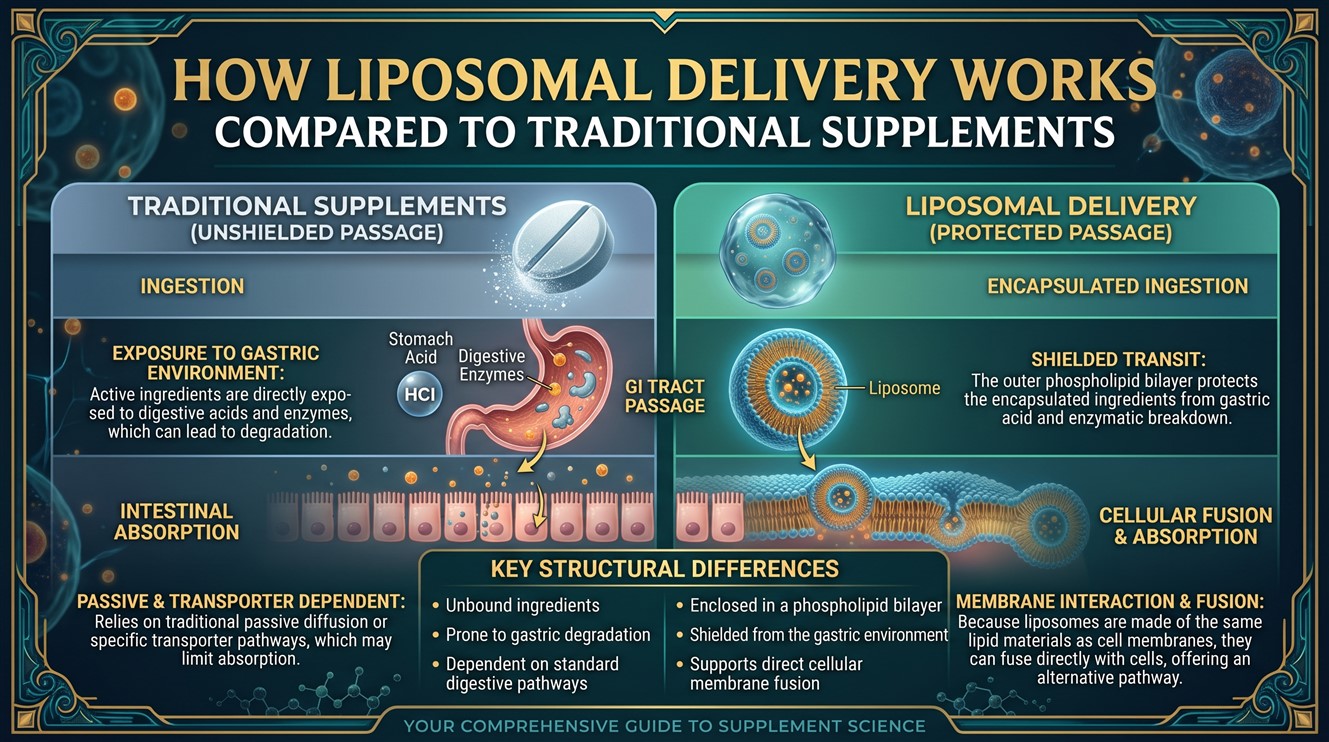
Swallow a plain capsule and the ingredient meets your gut head on. Stomach acid, enzymes and bile all act on it first.
A liposome puts a wall between the ingredient and that harsh setting. The idea is simple. Wrap the ingredient. Shield it on the way through. Makers say the aim is better absorption.
That is the theory every liposomal label leans on. Whether it holds for one product depends on how well the liposomes were made. Size matters. So does the share of the ingredient that ends up inside them. A bottle can say “liposomal” and still hold mostly loose ingredient.
Liposomal Bioavailability vs Standard Formulas
A standard vitamin is often a powder in a tablet or capsule. A liposomal formulation is often a liquid or gel. It may taste of lecithin. It usually costs more per serving.
The research question here is bioavailability. That means how much of a dose reaches the bloodstream, and how fast. Vitamin C has the most human data so far.
One 2021 crossover study gave healthy adults one dose of each form. The team then tracked blood levels for several hours. Liposomal vitamin C came out 1.77 times more bioavailable than the non-liposomal form. The liposomes in that study were under 100 nanometers wide.
Keep the size of that finding in mind. It was one small study. It used a single dose. Its authors work for an ingredient maker. It tracked blood levels and nothing else. One study is not proof that every liposomal product acts the same way.
Liposomal Supplement vs Water Soluble Formulas
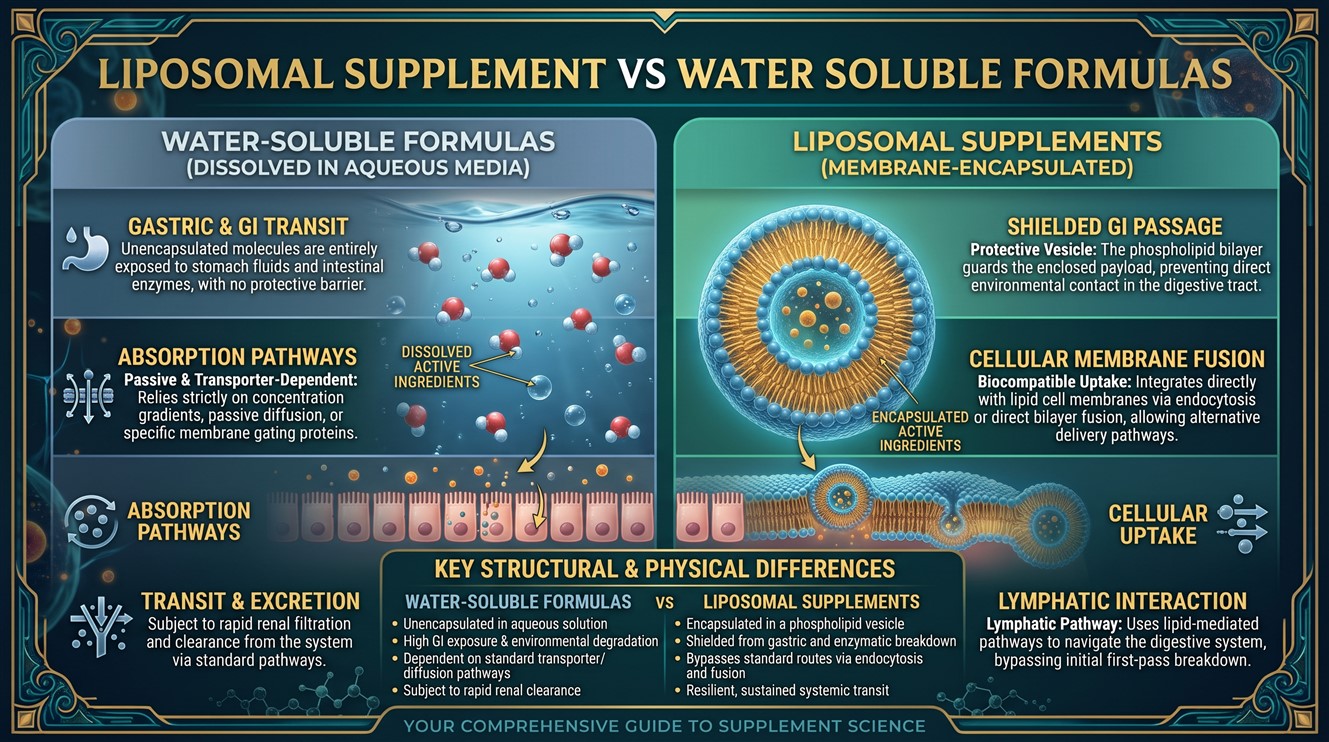
Water soluble and nano formulas take a different route. They break an oil into tiny drops, held in water by an emulsifier. No bilayer wall surrounds each drop.
Sellers often treat the two as the same thing. They are not. A liposome is a closed ball with a membrane. A nano drop is just oil with a coat of emulsifier. Both aim to mix an oily ingredient into a liquid. Only one builds a liposome to do it.
If a label says “water soluble” and never says “liposomal,” assume it is an emulsion.
Common Liposomal Products: Vitamin C, Glutathione, NAD+ and CBD
Most liposomal products on the market fall into four groups. Three are liposomal supplements: vitamin C, glutathione and NAD+. The fourth is cannabinoids, which follow different rules.
Among liposomal vitamins, vitamin C is the biggest. It is a water-soluble nutrient, so it sits in the core of the liposome. We cover the format in detail in our liposomal vitamin C guide.
Glutathione comes next. It is a small molecule built from three amino acids, and it is often sold as a liquid. Our page on liposomal glutathione walks through the label details.
NAD+ is newer to the format. It is a molecule every cell uses. Liposomal NAD+ products have grown fast in the last few years. See our liposomal NAD+ article for how those labels read.
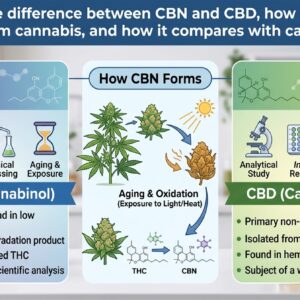
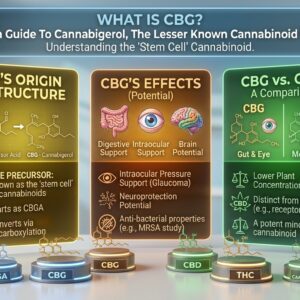
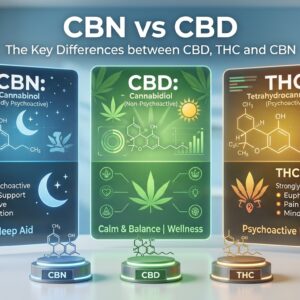
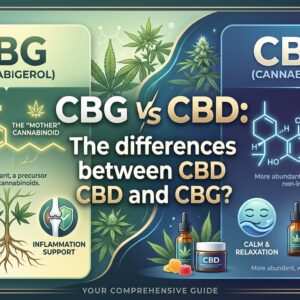
Cannabinoids make up the fourth group. CBD, CBG and CBN are oily, so they sit in the bilayer wall, not the core. Our full write-up on liposomal CBD oil covers that format in depth.
CBD differs from the other three in one legal way. The FDA has found that CBD products fall outside the legal supplement category. So a liposomal CBD oil is a hemp product, whatever format it comes in.
Why Hemp Therapies Built Its Line Around Liposomes
Gary McDonald founded Hemp Therapies. His author profile on this site says he has worked in the CBD trade since 2015. The company began in New York. Its homepage says the founder “envisioned an innovative solution to overcome industry limitations.”
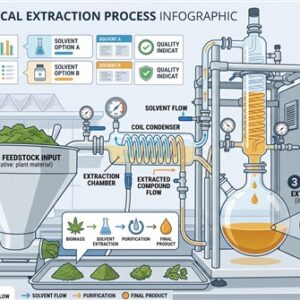
The company’s own “why” page ties that to liposomes. It describes “liposomal technology designed to encapsulate hemp-based cannabinoids into one holistic product.” The extraction step is solventless CO2.
Today the liposomal line runs to four oils, each in a 2oz bottle. They are full spectrum CBD, broad spectrum CBD, CBG, and a CBN isolate with no detectable THC. Each has its own product page, starting with the full spectrum liposomal CBD oil.
How to Read a Liposomal Formulation Label
The word “liposomal” on a label carries no number. Two figures turn it into a real spec.
The first is particle size. FDA guidance for liposome drugs asks makers to report particle size, as a mean and a distribution profile. The second is what the trade calls encapsulation efficiency. That is the share of the ingredient that sits inside the liposomes, not loose.
That guidance covers prescription drugs, not shop products. But the two figures make a fair yardstick for labels of any kind.
Other liposomal technology things worth checking
- Phospholipid source. Soy and sunflower lecithin are the most common. Some people avoid soy. – Strength per serving. Look for milligrams per ml and per drop, not just the big number on the front. – Liquid or capsule. Liquid liposomal products are the classic format. Some capsules hold dried liposomes. Others hold none at all. – A batch number. It should tie the bottle to a lab report from an outside lab.
Where to Buy Liposomal Vitamins
Start with the label, not the sales pitch. Check the strength per serving and look for a batch number.
You can compare our four liposomal oils side by side in the Hemp Therapies liposomal range.
These statements have not been evaluated by the Food and Drug Administration. This product is not intended to diagnose, treat, cure or prevent any disease. If you are pregnant or nursing, speak with your healthcare provider before use.
Educational and Regulatory Disclaimer
This article is for educational and informational purposes only and is not medical advice. It does not recommend a dose or claim that a dietary supplement or CBD product diagnoses, treats, cures, mitigates, or prevents any disease. Dietary-supplement structure/function and general-well-being claims must be truthful, non-misleading, and substantiated; a disclaimer does not replace adequate evidence.3 Consult a qualified healthcare professional before using a dietary supplement, especially if you are pregnant or nursing, take medication, have a medical condition, or are considering a high dose.
These statements have not been evaluated by the Food and Drug Administration. This product is not intended to diagnose, treat, cure, or prevent any disease.